Showing posts with label Maps. Show all posts

Thursday, October 3, 2024

Octagon Open Houses | October 20 and 21st, 2024


The Octagon State Memorial, Newark Earthworks Map. Image courtesy of the Ancient Ohio Trail.
The Octagon State Memorial, Newark Earthworks Map.
Image courtesy of the Ancient Ohio Trail.

The Octagon State Memorial is one of the most spectacular surviving remnants of the Newark Earthworks and is part of the Hopewell Ceremonial Earthworks.

The Octagon is connected to a perfectly circular enclosure 1,054 feet in diameter. The architecture of the Octagon Earthworks encodes a sophisticated understanding of geometry and astronomy. It is a National Historical Landmark and part of the Hopewell Ceremonial Earthworks UNESCO World Heritage site.

Simulated moonrise over the Newark Earthworks' observatory mound as it would have been 200 B.C. - 400 A.D. Image Courtesy of the Ancient Ohio Trail and CERHAS of the University of Cincinnati.

The precise geometry of Newark’s circle-octagon centers on its axial center line, beginning at the center of the Observatory Mound and pointing 38 degrees north of east. It’s a long line of sight which, if the site were cleared of trees, would lead the eye to a precise point on distant horizon. From here, as a result of generations of careful measurements and designing, the American Indians 2,000 years ago could predict, and bear witness to, the return of the moon to its northernmost position – just once every 6,789 days.

The movements of the moon are complex. Nowadays, we notice that the moon has different phases over about 29 days. But the builders of the earthworks noticed much more complicated lunar patterns: first, about every four weeks its rising point swings back and forth between the southeast and the northeast; and second, the width of this angle expands very slowly over about 9 1/3 years (about 3395 days), and then contracts again at the same rate. The moon’s setting points move the same way across the western horizon.

So there are eight points where the moon appears to reverse direction along the horizon during this long, complex cycle. Remarkably, all eight are marked precisely by these earthen walls and gateways. The architecture here tells us which one mattered the most: the extreme northernmost moonrise perfectly aligns along the central axis of the Octagon. This happened only once in 18.6 years or 6,789 days.

Portions of the Octagon Earthworks is open to the public during daylight hours 365 days a year, but much of the site is used as a private golf course for most of the year, so access is restricted. Five times this year, however, golfing is suspended and the entire site is made available to the general public.

The grounds of the Octagon State Memorial [external link] will be open to the public for general strolling and viewing from sunrise to sunset.

Octagon State Memorial, 125 N. 33rd Street, Newark, OH 43055

Take your tour with you, with The Ancient Ohio Trail [external link].

We hope to see you there!

These are the last public open houses of 2024.

For more information, visit Ohio History Connection [external link].


Monday, July 1, 2024

Octagon Open House | July 22, 2024

The Octagon State Memorial, Newark Earthworks Map. Image courtesy of the Ancient Ohio Trail.
The Octagon State Memorial, Newark Earthworks Map.
Image courtesy of the Ancient Ohio Trail.

The Octagon State Memorial is one of the most spectacular surviving remnants of the Newark Earthworks and is part of the Hopewell Ceremonial Earthworks.

The Octagon is connected to a perfectly circular enclosure 1,054 feet in diameter. The architecture of the Octagon Earthworks encodes a sophisticated understanding of geometry and astronomy. It is a National Historical Landmark and part of the Hopewell Ceremonial Earthworks UNESCO World Heritage site.

Simulated moonrise over the Newark Earthworks' observatory mound as it would have been 200 B.C. - 400 A.D. Image Courtesy of the Ancient Ohio Trail and CERHAS of the University of Cincinnati.

The precise geometry of Newark’s circle-octagon centers on its axial center line, beginning at the center of the Observatory Mound and pointing 38 degrees north of east. It’s a long line of sight which, if the site were cleared of trees, would lead the eye to a precise point on distant horizon. From here, as a result of generations of careful measurements and designing, the American Indians 2,000 years ago could predict, and bear witness to, the return of the moon to its northernmost position – just once every 6,789 days.

The movements of the moon are complex. Nowadays, we notice that the moon has different phases over about 29 days. But the builders of the earthworks noticed much more complicated lunar patterns: first, about every four weeks its rising point swings back and forth between the southeast and the northeast; and second, the width of this angle expands very slowly over about 9 1/3 years (about 3395 days), and then contracts again at the same rate. The moon’s setting points move the same way across the western horizon.

So there are eight points where the moon appears to reverse direction along the horizon during this long, complex cycle. Remarkably, all eight are marked precisely by these earthen walls and gateways. The architecture here tells us which one mattered the most: the extreme northernmost moonrise perfectly aligns along the central axis of the Octagon. This happened only once in 18.6 years or 6,789 days.

Portions of the Octagon Earthworks is open to the public during daylight hours 365 days a year, but much of the site is used as a private golf course for most of the year, so access is restricted. Five times this year, however, golfing is suspended and the entire site is made available to the general public.

The grounds of the Octagon State Memorial [external link] will be open to the public for general strolling and viewing from sunrise to sunset.

Octagon State Memorial, 125 N. 33rd Street, Newark, OH 43055

Take your tour with you, with The Ancient Ohio Trail [external link].

We hope to see you there!

Can't make it this time? The other Open Houses this year are: 

  • Sunday, October 20th
  • Monday, October 21st

For more information, visit Ohio History Connection [external link].

Thursday, March 28, 2024

Octagon Open Houses | April 14th and 15th, 2024

The Octagon State Memorial, Newark Earthworks Map. Image courtesy of the Ancient Ohio Trail.
The Octagon State Memorial, Newark Earthworks Map.
Image courtesy of the Ancient Ohio Trail.

The Octagon State Memorial is one of the most spectacular surviving remnants of the Newark Earthworks and is part of the Hopewell Ceremonial Earthworks.

The Octagon is connected to a perfectly circular enclosure 1,054 feet in diameter. The architecture of the Octagon Earthworks encodes a sophisticated understanding of geometry and astronomy. It is a National Historical Landmark and part of the Hopewell Ceremonial Earthworks UNESCO World Heritage site.

Simulated moonrise over the Newark Earthworks' observatory mound as it would have been 200 B.C. - 400 A.D. Image Courtesy of the Ancient Ohio Trail and CERHAS of the University of Cincinnati.

The precise geometry of Newark’s circle-octagon centers on its axial center line, beginning at the center of the Observatory Mound and pointing 38 degrees north of east. It’s a long line of sight which, if the site were cleared of trees, would lead the eye to a precise point on distant horizon. From here, as a result of generations of careful measurements and designing, the American Indians 2,000 years ago could predict, and bear witness to, the return of the moon to its northernmost position – just once every 6,789 days.

The movements of the moon are complex. Nowadays, we notice that the moon has different phases over about 29 days. But the builders of the earthworks noticed much more complicated lunar patterns: first, about every four weeks its rising point swings back and forth between the southeast and the northeast; and second, the width of this angle expands very slowly over about 9 1/3 years (about 3395 days), and then contracts again at the same rate. The moon’s setting points move the same way across the western horizon.

So there are eight points where the moon appears to reverse direction along the horizon during this long, complex cycle. Remarkably, all eight are marked precisely by these earthen walls and gateways. The architecture here tells us which one mattered the most: the extreme northernmost moonrise perfectly aligns along the central axis of the Octagon. This happened only once in 18.6 years or 6,789 days.

Portions of the Octagon Earthworks is open to the public during daylight hours 365 days a year, but much of the site is used as a private golf course for most of the year, so access is restricted. Five times this year, however, golfing is suspended and the entire site is made available to the general public.

The grounds of the Octagon State Memorial [external link] will be open to the public for general strolling and viewing from sunrise to sunset.

Octagon State Memorial, 125 N. 33rd Street, Newark, OH 43055

Take your tour with you, with The Ancient Ohio Trail [external link].

We hope to see you there!

Can't make it this time? The other Open Houses this year are: 

  • Monday, July 22nd
  • Sunday, October 20th
  • Monday, October 21st

For more information, visit Ohio History Connection [external link].

Tuesday, March 28, 2023

April 14, 2023: How Indigenous Americans Discovered Europe | Barbara A. Hanawalt Public Lecture

Flyer for Caroline Dodds Pennock lecture on April 14, 2023. Image courtesy of the Center for the Medieval and Renaissance Studies. All text to the left.

7 - 8:30 p.m.

Free and Open to the Public.

Faculty Club Grand Lounge

181 Oval Dr. S.

Columbus, OH 43210

The 2023 Annual Barbara A. Hanawalt Public Lecture will feature Caroline Dodds Pennock, Senior Lecturer in International History at the University of Sheffield.  

History has long told the tale of Christopher Columbus’s ‘discovery’ of the Americas in 1492, but what is often forgotten is that Indigenous Americans ‘discovered’ Europe at almost the same moment. Tens of thousands of Native people crossed the Atlantic from as early as 1493, but their experiences are largely absent from popular understandings of the past.

For tens of thousands of Aztecs, Maya, Totonacs, Inuit and others, Europe comprised savage shores, a land of riches and marvels, yet perplexing for its brutal disparities of wealth and quality of life, and its baffling beliefs. The story of these Indigenous Americans abroad is a story of abduction, loss, cultural appropriation, and, as they saw it, of apocalypse—a story that has largely been absent from our collective imagination of the times.

From the Brazilian ‘king’ who met Henry VIII, to the Aztecs who mocked up human sacrifice at the court of Charles V; from the Inuk baby who was put on show in a London pub to the many enslaved people laboring in Spanish homes and workplaces: here are people who were rendered exotic, demeaned and marginalized, but whose worldviews and cultures had a profound impact on European civilization. Join Dr Caroline Dodds Pennock to hear the remarkable stories of some of the earliest Indigenous voyagers and learn how their experiences can transform popular perceptions of the past.

Dr. Caroline Dodds Pennock is the author of On Savage Shores: How Indigenous Americans Discovered Europe (2023). She is probably best known as the only British Aztec historian. Her first book, Bonds of Blood: Gender, Lifecycle and Sacrifice in Aztec Culture (2008, PB: 2011) won the Royal Historical Society’s Gladstone Prize for 2008.

As well as pestering people on twitter @carolinepennock, Caroline also works as a popular history writer, consultant, and 'talking head' expert for TV and radio, having appeared on programs for broadcasters including the BBC, Channel 4, Sky, the Smithsonian Channel and Netflix.

This event is free and open to the public. Co-hosted by the Center for Medieval and Renaissance Studies, The Department of Spanish and Portuguese, the American Indian Studies Program and the Humanities Institute.


Parking: The nearest public parking available is at the Ohio Union North and and Ohio Union South Garages (North is available to visitors after 4 p.m.). For more information, follow the links to CampusParc. 

The Humanities Institute and its related centers host a wide range of events, from intense discussions of works in progress to cutting-edge presentations from world-known scholars, artists, and activists, and everything in between. In our current moment of riding the unpredictable currents of the pandemic, we reaffirm the value of in-person engagement. We strive to amplify the energy in the room. But we also recognize the need to be careful and the fact that not all our guests will be able to visit our space. We, therefore, will continue to offer Zoom access to all our events upon request. If you wish to have such access, please send your request to cmrs@osu.edu or moriarty.8@osu.edu.

For more information: https://go.osu.edu/cmrs_cp_fl

Thursday, November 3, 2022

#LandBack: Histories of Restoring Indigenous Presence Webinar with Dr. Doug Kiel

November 17, 2022
7 PM EST (6 PM CT)

Free and open to the public.

Dr. Doug Kiel (Oneida Nation), Northwestern University. Image Courtesy of Dr. Kiel.The Newark Earthworks Center is hosting Dr. Doug Kiel (Oneida Nation), Northwestern University, who will present "#LandBack: Histories of Restoring Indigenous Presence" on Zoom at 7 PM EST.  

Land is at the heart of Indigenous identities, and histories of U.S. colonialism are largely defined by attempts to separate Native people from their collective inheritance. Native communities have reacquired territory through a variety of means in recent years, which has often been met with resentful opposition at the local level. The Land Back movement is nonetheless gaining steam, accruing victories, and making a better world. This present-day movement has roots that reach deep into the past, and has high stakes for the future. Land is at the heart of Indigenous identities, and histories of U.S. colonialism are largely defined by attempts to separate Native people from their collective inheritance. Native communities have reacquired territory through a variety of means in recent years, which has often been met with resentful opposition at the local level. The Land Back movement is nonetheless gaining steam, accruing victories, and making a better world. This present-day movement has roots that reach deep into the past, and has high stakes for the future.

7:00 – 8:00 PM EST 

We strive to host inclusive, accessible events that enable all individuals, including individuals with disabilities, to engage fully. To request an accommodation or for inquiries about accessibility, please contact Dr. John Low at 740-755-7857 or low.89@osu.edu . At least two weeks' advance notice will help us to provide seamless access.

There will be 15 minutes for a Question and Answer session at the end of the webinar. Please submit your questions in the chat.

Dr. Doug Kiel (Ph.D., University of Wisconsin–Madison, 2012) is a citizen of the Oneida Nation and studies Native American history, with particular interests in the Great Lakes region and twentieth century Indigenous nation rebuilding. He is working on a book manuscript entitled Unsettling Territory: Oneida Indian Resurgence and Anti-Sovereignty Backlash. The Oneida Nation of Wisconsin, a community that had been dispossessed of their New York homelands in the early nineteenth century, yet again suffered devastating land losses as a result of the Dawes Act of 1887—a policy that President Theodore Roosevelt once called “a mighty pulverizing engine to break up the tribal mass.” Kiel’s book examines how the Oneida Nation’s leaders strengthened the community’s capacity to shape their own future by envisioning, deliberating, and enacting a dramatic reversal of fortune during the twentieth century. His book also examines the origins of recent litigation between the Oneida Nation and the Village of Hobart, a mostly non-Native municipality that is located within the boundaries of the Oneida Reservation and seeks to block the tribe from recovering land that was lost a century ago.

Speaker series as part of Indigenous Ohio: OSU and Native Arts and Humanities Past and Present grant.  Sponsored by the Newark Earthworks Center and the Global Arts + Humanities Discovery Theme.

Kind thanks to Jared Gardner Department of English and Director of Popular Culture Studies for assisting in set up and hosting this web presentation.

Monday, February 28, 2022

Roundtable One | On Indigenous Studies

Michael Charles (left) and Gregorio Gonzales (right). Image courtesy of The Ohio State University.

 This series of roundtable webinars features presentations and moderated conversations that foster cross-disciplinary exchange. Each roundtable showcases two to three members of the Global Arts + Humanities Discovery Theme's post-MFA and postdoctoral cohort whose work shares disciplinary, methodological and/or topical alignment.

March 11th, 2022

RSVP

11-12 AM on Zoom

If you require an accommodation such as live captioning or interpretation to participate in this event you can request this on the Zoom RSVP above.

Roundtable One: On Indigenous Studies

  • Michael Charles | Postdoctoral Researcher, Newark Earthworks Center
  • Gregorio Gonzales | Postdoctoral Researcher, Department of Comparative Studies
  • Moderator: Melissa Curley | Associate Professor, Department of Comparative Studies
  • Moderator: John Low | Director of Newark Earthworks Center

About GAHDT’s post-MFA and postdoctoral program

This program supports post-MFA and postdoctoral researchers and creative practitioners and provides professional development opportunities with the goal of facilitating their entry into tenure-track positions in the academic marketplace and the public arts and humanities. The valuable presence of these researchers and practitioners adds intellectual energy and vitality to the College of Arts and Sciences as a whole, contributing to interdisciplinary collaboration between academic units and the development of innovative scholarship and curricula.


For more information, visit the Global Arts + Humanities Discovery Theme.

Wednesday, October 13, 2021

Octagon Open House | October 17, 2021

October 17, 2021

PDF of Octagon Open House Flyer. English OCR Text Enabled.
PDF of Octagon Open House Flyer.
English OCR Text Enabled.
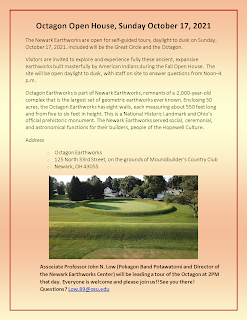
The site will be open daylight to dusk. 

For health and safety reasons, there will be no guided tours. Ohio History Connection staff will be on hand from noon to 4 p.m. to answer questions. Please practice social distancing and wear a mask while on site.

Associate Professor John N. Low [Pokagon Band of Potawatomi] and Director of the Newark Earthworks Center will be leading a tour of the Octagon at 2 PM.

Everyone is welcome and please join us!! See you there!


Dr. Low will also be leading a tour of the Newark Earthworks Center Exhibit at the LeFevre Art Gallery  on the OSU Newark Campus at 4 PM.

LeFevre Art Gallery

Questions? low.89@osu.edu

The Octagon State Memorial is one of the most spectacular surviving remnants of the Newark Earthworks. The Octagon is connected to a perfectly circular enclosure 1,054 feet in diameter. The architecture of the Octagon Earthworks encodes a sophisticated understanding of geometry and astronomy. It is a National Historical Landmark and is on track to become a World Heritage site! Portions of the Octagon Earthworks is open to the public during daylight hours 365 days a year, but much of the site is used as a private golf course for most of the year, so access is restricted. Four times each year, however, golfing is suspended and the entire site is made available to the general public.

For more information, visit: 
https://www.ohiohistory.org/participate/event-calendar/newark-earthworks/octagon-earthworks-open-house-(7) .

Friday, September 24, 2021

Potawatomi Removals: Forced and "Voluntary"


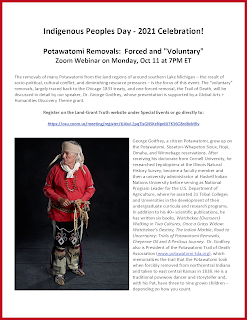
George Godfrey (Citizen Band Potawatomi) in regalia. Image Courtesy of George Godfrey.
George Godfrey (Citizen Band Potawatomi) in regalia.
Image Courtesy of George Godfrey.

October 11, 2021

7 PM

Free, Registration required for Zoom Event.

 https://osu.zoom.us/meeting/register/tJAkd-2pqTIsGNSKeNpdiIJ7K36O8rd8xMRv

If you require an accommodation such as live captioning or interpretation to participate in this event, or other accommodations, please contact the Humanities Institute.

PDF of October 11, 2021 George Godfrey Event Flyer. English OCR Text Enabled..
PDF of October 11, 2021
George Godfrey Event Flyer.
English OCR Text Enabled.
The removals of many Potawatomi from the land regions of around southern Lake Michigan – the result of socio-political, cultural conflict, and diminishing resource pressures – is the focus of this event. The “voluntary” removals, largely traced back to the Chicago 1833 treaty, and one forced removal, the Trail of Death, will be discussed in detail by our speaker, Dr. George Godfrey, whose presentation is supported by a Global Arts + Humanities Discovery Theme grant.

George Godfrey, a Citizen Potawatomi, grew up on the Potawatomi, Sisseton-Whapeton Sioux, Hopi, Omaha, and Winnebago reservations. After receiving his doctorate from Cornell University, he researched Lepidoptera at the Illinois Natural History Survey, became a faculty member and then a university administrator at Haskell Indian Nations University before serving as National Program Leader for the U.S. Department of Agriculture, where he assisted 31 Tribal Colleges and Universities in the development of their undergraduate curricula and research programs.  In addition to his 40+ scientific publications, he has written six books, Watchekee (Overseer) Walking in Two CulturesOnce a Grass Widow: Watchekee’s Destiny, The Indian MarbleRoad to Uncertainty: Trials of Potawatomi RemovalsCheyenne Oil and A Perilous Journey.  Dr. Godfrey also is President of the Potawatomi Trail of Death Association (www.potawatomi-tda.org), which memorializes the trail that the Potawatomi took when forcibly removed from northcentral Indiana and taken to east central Kansas in 1838. He is a traditional powwow dancer and storyteller and, with his Pat, have three to nine grown children ‒ depending on how you count.

For more information,

Visit:

Monday, May 24, 2021

UNESCO Honor for Ancient Earthworks Hits Snag

Map of the Newark Earthworks, Plate XXV. Ancient Monuments of the Mississippi Valley. Squier & Davis, Smithsonian Institute, 1848. Page 67.
Map of the Newark Earthworks, Plate XXV.
Ancient Monuments of the Mississippi Valley.
Squier & Davis, Smithsonian Institute, 1848. Page 67.

April 17, 2021.

Mary Annette Pember, of Indian Country Today, has reviewed the current situation of the Octagon State Memorial within her thoughtful article about the Ohio Supreme Court's pending ruling on the lease of Ohio's official state prehistoric monument.

"One thing stands between the 2,000-year-old Octagon Earthworks in Newark, Ohio, and a nomination to the United Nations Educational, Scientific and Cultural Organization’s (UNESCO) World Heritage List.
It’s a golf course that leased the land nearly 100 years ago."

To read the full articleclick here.

For more information,
Visit:

Tuesday, February 9, 2021

Dakota and Ojibwe Skies Virtual Discussion | March 9th, 2021

You are invited to attend “Dakota and Ojibwe Skies” to learn how our American Indian ancestors used the moon, earthen architecture, and a turtle’s shell to predict astronomical events with remarkable precision. 

The virtual discussion will be led by Dr. Jim Rock, a citizen of the Dakota Nation, is a faculty member in the Department of Physics and Astronomy and Director of Indigenous Programming for the Marshall W. Alworth Planetarium at the University of Minnesota Duluth. In 2014 he co-authored the book Makoċe Wiċaŋḣpi Wowapi | D(L)akota Star Map Constellation Guide and has co-published several journal articles on Dakota sacred mound and cave sites.

 He will discuss both topics from his published works in addition to local connections with the Newark Earthworks and the Serpent Mound in Peebles, Ohio.


Free and Open to the Public.
 
7 to 8 p.m. 

Online Registration for this virtual event is required 
through the  Granville Public Library.

If you require an accommodation such as live captioning or interpretation to participate in this event, or other accommodations, please contact carpenter.554@osu.edu . 
Requests made by February 22 will help provide seamless access.
Blowing Off STEAM Logo.

This event is part of the Blowing off STEAM (science, technology, engineering, art, mathematics) informal community-based discussion series. Blowing off STEAM is a collaboration between The Ohio State University at Newark, Denison University, and the Granville Public Library. Also sponsored by the Newark Earthworks Center, the Department of Astronomy, and the Global Arts + Humanities/Indigenous Arts and Humanities Initiative.


For more information,
Visit:

Thursday, July 23, 2020

Supreme Court ruling 'reaffirmed' sovereignty

July 9, 2020.
Kolby KickingWoman, of Indian Country Today, has reviewed an exciting article about the U.S. Supreme Court's ruling that the Muscokgee (Creek) Nation's reservation boundaries stand.

"In the 5-4 decision, the nation’s highest court said Congress never explicitly “disestablished” the 1866 boundaries of the Muscogee (Creek) Nation.

“Today we are asked whether the land these treaties promised remains an Indian reservation for purposes of federal criminal law. Because Congress has not said otherwise, we hold the government to its word," according to the majority opinion written by Justice Neil Gorsuch.

Gorsuch was joined in the majority by Justices Ruth Bader Ginsburg, Stephen Breyer, Sonia Sotomayor and Elena Kagan."

To read the full articleclick here.

"Tribal sovereignty refers to the right of American Indians and Alaska Natives to govern themselves. The U.S. Constitution recognizes Indian tribes as distinct governments and they have, with a few exceptions, the same powers as federal and state governments to regulate their internal affairs. Sovereignty for tribes includes the right to establish their own form of government, determine membership requirements, enact legislation and establish law enforcement and court systems." 

For more information,
Visit:

Tuesday, May 29, 2018

TreeSearch

Treesearch. United States Department of Agriculture and the U.S. Forest Service.

"Treesearch is an online system for sharing free, full text publications by Research and Development scientists in the US Forest Service. Included in Treesearch are scholarly works published by the agency as well as those published by others, including papers appearing in journals, conference proceedings, or books. All publications appearing in Treesearch are based on peer reviewed research to make sure they provide the best scientific information possible."
-United States Department of Agriculture & U.S. Forest Service.

Currently there are 50, 586 Publications available to search!

Filter by Topics
  • Ecology, Ecosystems, & Environment
  • Wildlife (or Fauna)
  • Natural Resource Management & Use
  • Inventory, Monitoring, & Analysis
  • Fire
  • Forest & Plant Health
  • Climate Change
  • Environment & People
  • Forest Products

Search by:
  • Keywords (All fields) or Title
  • Last Name of Author
  • Date Range: 1902-2018
  • FS Series: Active/Inactive Stations, Series, Volume Number
Subscribe to changes in your search!
Arrange by:
  • Records per page: 20-100
  • Sort by 
    • Relevance
    • Year (Most Recent ->)
    • Station
    • Title
    • Author
  • Search within __ - __ pages of results
A Small Sample of Examples include: