Tuesday, October 27, 2015

Living Maya Time: Sun, Corn, and the Calendar

Living Maya Time: Sun, Corn, and the Calendar-National Museum of the American Indian.

"The Maya of Mesoamerica are renowned for their precise calendars 
and their knowledge of astronomy.
Through systematic observations conducted over thousands of years, Maya skywatchers developed complex and accurate calendars that continue to mark agricultural and ceremonial cycles today. Join us in an exploration of the Maya Calendar system and its intricate cycles. Hear the voices of contemporary Maya people as they weave their past and present together, and share with us their living traditions of Maya time."

Available in English and Español.

The Maya
"Today, more than seven million Maya live in their original homelands of Mesoamerica and in countries all over the world. Two thousand years ago, the ancient Maya developed one of the most advanced civilizations in the Americas."
  • Creation Story of the Maya
  • The Maya People
  • The Maya World
  • Connecting Earth and Sky
Maya Sun
  • The Maya and the Sun
  • Sun, Corn, and the Calendar
  • Maya Math Game
Calendar
  • The Calendar System
  • Maya Calendar Converter
  • Reading the Calendar Glyphs
Corn and Maya Time
  • Corn and Calendar Traditions
  • The Sun Above, The Sun Below
2012: Resetting the Count
  • The Meaning of 2012
  • Maya Opinion of 2012
For Teachers (available in PDF form)
  • Living Maya Time Lotería Game 
  • Let's Multiply- Maya Style!
  • Observing and Tracking Shadows
  • What;'s Moving?
  • Curricula Connections for the Standards of Learning
Resources
  • Additional Site Related Resources
  • Images
  • Online Resources
  • Print Resources 
    • for Students
    • for Research
  • Site Glossary (PDF)

Friday, October 23, 2015

Archaeologists Perform Survey of Schoenbrunn Village Site

Jarrod Burks of Ohio Valley Archaeology uses ground penetrating radar  at historic Schoenbrunn Village during an archaeological dig.  Image Courtesy of Jim Cummings and TimesReporter.com.
Jarrod Burks of Ohio Valley Archaeology uses ground penetrating radar
at historic Schoenbrunn Village during an archaeological dig.
Image Courtesy of Jim Cummings and TimesReporter.com.
July, 26, 2015.
Jon Baker, of TimesReporter.com, has written an exciting article about  Ohio Valley Archaeology's recent geophysical survey of Schoenbrunn Village;
 a Moravian and Delaware village site from the 1700s.

"The survey will set up a baseline grid so future survey and archaeological projects can build on what has already been done at the site, and future excavations will be able to make use of the survey results. [Jarrod] Burks used both a handheld magnetometer and ground-penetrating radar in his work."

To read the full articleclick here.

Wednesday, October 21, 2015

Indigenous Cosmology Wins: Kaibab Paiute Tribe Nets Dark Skies Award

The Kaibab Paiute's dark skies logo, emblazoned with ppotseev, the word for star. Image Courtesy of the Kaibab Paiute Tribe and Indian Country Today.
The Kaibab Paiute's dark skies logo, emblazoned with ppotseev, the word for star.
Image Courtesy of the Kaibab Paiute Tribe and Indian Country Today.
July, 10, 2015.
Anne Minard, of Indian Country Today, has written a brief article about the Kaibab Paiute Tribe.

"A small tribe in northern Arizona has become the first “dark sky nation” in honor of its efforts to protect unspoiled nighttime views and a culture that is tied to the stars."

To read the full articleclick here.

For more information,

Monday, October 19, 2015

America’s Largest Earthwork, Cahokia’s Monks Mound, May Have Been Built in Only 20 Years, Study Says

An aerial view of Monks Mound, Cahokia.  Image Courtesy of Western Digs.
An aerial view of Monks Mound, Cahokia.
Image Courtesy of Western Digs.
September, 17, 2015.
Blake De Pastino, of Western Digs, has written a informative article about recent research which suggests that Cahokia's largest remaining mound, Monk's Mound, may have been built in 20 years. Cahokia is an American Indian city which was larger than London, England of the same time period
 (Cahokia began to decline around AD 1200).

"In addition to these finds, the researchers discovered another striking aspect of Monks Mound’s construction: Parts of it appear to have been built from whole blocks of sod, 
rather than basketfuls of soil."

To read the full articleclick here.

For more information,
Visit:

Thursday, October 15, 2015

From Space to Indigenous Ancestral Engineering: Commander John Herrington Charts New Territory

Chickasaw astronaut John Herrington, the first Native American in space,  flew with an eagle feather.  Image Courtesy of John Herrington and Indian Country Today.
Chickasaw astronaut John Herrington, the first Native American in space,
flew with an eagle feather.
Image Courtesy of John Herrington and Indian Country Today.
June, 6, 2015.
Terri Hansen, of Indian Country Today, has written an brief article about Commander John Herrington's missions into space with NASA and his research into engaging and motivating Native students in the STEM (Science, Technology, Engineering, and Math) fields.

"Native American and Alaskan Natives earned just 0.6 percent of master’s degrees in science and engineering in 2009, according to the National Science Foundation—a dismal statistic that highlights the importance of his research and of his motivation to study different approaches to engage Native students in STEM education."

To read the full articleclick here.

For more information,
Visit:

Tuesday, October 13, 2015

National Museum of the American Indian: Educational Resources

National Museum of the American Indian: Education Resources

Collections

Did You Know?

  • Do all Indians live in tipis?
  • What is the correct terminology: American Indian, Indian, Native American, or Native?
  • How many Indians lived in America before 1492?
  • Before Contact with Europeans, did Indians make all their clothes from animal skins?
  • Do Indians do rain dances?
  • Do Indians have to pay taxes?

Educator E-Newsletter

"Learn about the NMAI's educational resources—including curriculum for the classroom, teacher workshops, and educational strategies—in the museum’s free, quarterly teacher e-newsletter."
Available online as PDFs.
  • Spring 2015
  • Winter 2015
  • Fall 2014
  • September 2014
  • Spring 2014
  • March 2014
  • Winter 2014

Educator Programs

"Professional development opportunities for teachers at the National Museum of the American Indian can benefit educators in all subject areas. Workshops span a range of topics and enable teachers to discover analytical approaches to connect the museum's collections and content with classroom teaching strategies. Sessions help educators explore new content about American Indian cultures and history and encourage new methods for teaching with objects in the classroom. Workshops include take-home materials and classroom resources, as well as new ideas for interdisciplinary curriculum connections."

Classroom Lessons

Nations or Regions


  • Manhatta to Manhattan: Native Americans in Lower Manhattan (PDF available)
    • "In this booklet you will learn about the Native people of Lower Manhattan and the lasting impressions they left on this area"
  • The Haudenosaunee Guide for Educators (PDF available)
    • " It was our hope to provide educators with a deeper and more integrated understanding of Haudenosaunee life, past and present. This guide is intended to be used as a supplement to your mandated curriculum. "
  • We Have a Story to Tell: Native Peoples of the Chesapeake (PDF available)
    • " intended for use with students in grades 9-12. Ways of life before contact with Europeans are briefly introduced. This is followed by coverage of the period of colonization (1607) through the present. The guide focuses especially on how Powhatan, Nanticoke, and Piscataway peoples responded to the upheavals that began with the colonial period. It includes activities that fix attention on critical contemporary issues that affect Native communities in the region"
      • Introduction for Teachers
      • Reading
        • Native Peoples of the Chesapeake Region and the Enduring Effects of Colonialism
      • Small Group Project and Class Presentation
        • Issues of Survival for Native Communities of the Chesapeake Region
      • Maps, Resources, Works Cited
  • Lone Dog's Winter Count: Keeping History Alive (PDF available)
      • Grade Level 4-8.
      • "Students learn about the oral culture and history-keeping of the Nakota people, who made the Lone Dog Winter Count. Then they create a monthly pictograph calendar of their own to document a year of their personal history"

Themes

Expressive Traditions


  • Smithsonian in Your Classroom: Native Dolls (PDF available)
    • "In our lesson plan we present the perspectives and experiences of Native doll makers describing how their work is keeping old traditions and developing new ones. These Native voices encourage students to examine dolls from the collections of the museum and to connect them to the diverse cultures, communities, and environments they represent. "
      • Background
      • Lesson Plan
      • Navajo Dolls
      • Inupiat Dolls
      • Ojibwe Doll
      • Seneca Dolls
      • Seminole Doll
      • Map
  • Identity by Design (Exhibit website)
    • tradition, change, and celebration in native women's dresses
      • Introduction
      • 19th-Century Style
      • Full Circle of Life
      • Indigenous Innovation
      • Forming Cultural Identity
      • Dancing in Beauty
      • The Powwow World
      • Resources
  • Fritz Scholder Study Guide (Grades 5-8) (PDF available)
    • "This lesson explains abstract expressionism through an examination of a Scholder landscape painting titled New Mexico No. 1. Students will also learn how art can make a statement about identity by exploring Scholder’s life and examining other works, including Heart Indian. Students will create a self-portrait based on the style of Scholder."
  • Fritz Holder: Indian/Not Indian (Exhibit website)
    • Introduction
    • Biography
    • Works
    • Press
    • Resources
    • Programs
    • Podcasts
  • Fritz Scholder Guide for Young People (7 & Up) (PDF available)
    • "This guide provides parents and children with background information, questions, and suggestions to help focus on a few of the pieces in this exhibit. First, read the biographical information on the back. Then, open the guide and: find the artwork pictured. read the background information in this guide. look at the piece as a whole, and then the colors, texture, and other small details. talk about what you see and how it makes you think and feel. compare the piece to others in the exhibit."
  • Looking at Fritz Scholder (PDF available)
    • "This activity guide is designed for you and your family to use together as you explore the works of Fritz Scholder on display in this exhibition. "

Thanksgiving

  • American Indian Perspectives on Thanksgiving (PDF available)
    •  a resource for teachers to use as a jumping-off point for more in-depth discussion. Discussion and other classroom ideas are included in each section."
  • Harvest Ceremony: Beyond the Thanksgiving Myth (PDF available)
    • "Contemporary celebrations of the Thanksgiving holiday focus on the idea that the “first Thanksgiving” was a friendly gathering of two disparate groups—or even neighbors—who shared a meal and lived harmoniously. In actuality, the assembly of these people had much more to do with political alliances, diplomacy, and an effort at rarely achieved, temporary peaceful coexistence. Although Native American people have always given thanks for the world around them, the Thanksgiving celebrated today is more a combination of Puritan religious practices and the European festival called Harvest Home, which then grew to encompass Native foods."
      • The First People
      • The Immigrants
      • Contact
      • The Harvest Celebration
      • The Wampanoag Today
      • Afterword
      • Classroom Discussion Topics

History

  • Native Words | Native Warriors (Exhibit website)
    •  Introduction
    • Native Languages
    • Code Talking
    • Survival
    • Boarding Schools
    • Coming Home
    • Recognition
    • Lesson Plan
    • Resources
* Links provided are not all that are available on the National Museum of the American Indian
This post is intended to inform; not reproduce the NMAI's website.

Monday, October 12, 2015

Instead of Columbus Day, some U.S. cities celebrate Indigenous Peoples' Day


October, 13, 2014.
Emanuella Grinberg, of CNN, has written an informative and thoughtful article about the recognition of the second Monday in October at Indigenous People's Day in certain cities and states. The purpose behind this decision is to "shift the holiday's focus from Christopher Columbus to the people he encountered in the New World and their modern-day descendants."

"The Italian explorer and his namesake holiday have long been controversial. Despite what American schoolchildren may have learned about when "Columbus sailed the ocean blue," supporters of Indigenous People's Day believe Columbus should not be celebrated for "discovering" America. Indigenous people had been living in the "New World" for centuries by the time he arrived, and his voyages established lasting connections between Europe and Americans that paved the way for its colonization, leading to the subjugation and decimation of the indigenous population."

To read the full articleclick here.

For more information,
Visit:

Wednesday, October 7, 2015

Earthworks Open House Focused on Fall Moon Rises

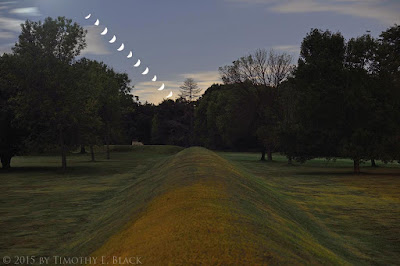
September 2015 time lapse of a lunar alignment at the Octagon State Memorial  by Timothy Black. Prints available upon request.
September 2015 time lapse of a lunar alignment at the Octagon State Memorial
 by Timothy Black. Prints available upon request.
October, 3, 2015.
Dr. Richard Shiels, former Director of  the Newark Earthworks Center, has written an informative article for the Newark Advocate about the upcoming Octagon Open House on October 11th
and lunar alignments at Octagon State Memorial, part of the Newark Earthworks.

"The octagon built 2000 years ago in what is today Newark and the octagon built in Chillicothe about the same time both align with all eight of these lunar standstills.

This fall, the moon is at roughly the halfway point of the 18.6 year cycle. The northern and southern maximum alignments occurred at the beginning of the cycle, in 2005 and 2006. The minimums are occurring this fall."

To read the full articleclick here.

We hope to see you there!

Octagon Open House October 11, 2015. PDF Flyer.

For more information,
Visit:

Monday, October 5, 2015

Last Octagon Open House of 2015!

September 2015 Time lapse of lunar alignment at the Octagon State Memorial  by Timothy Black. Prints available upon request.
September 2015 time lapse of a lunar alignment at the Octagon State Memorial
 by Timothy Black. Prints available upon request.

Don't forget to tour the Octagon State Memorial this weekend, October 11th, and learn 
about its amazing alignments with the 18.6 year cycle of the moon. 
This is the last Octagon Open House of 2015.

Free tours of the site, spear throwing with atlatls,
 and crafts will be offered from 1-4 PM.

Information for self-guided tours can be found on

The Ancient Ohio Trail


Newark, OH 43055

*Due to construction, approach the Octagon by taking 33rd Street North
 from Main Street in Newark.

We hope to see you there!


For more information, contact us at earthworks@osu.edu 
or call 740-345-8224.