Tuesday, March 31, 2015

Illinois' Cultural and Natural History: Native American Module

museumlinkIllinois. Native Americans Module
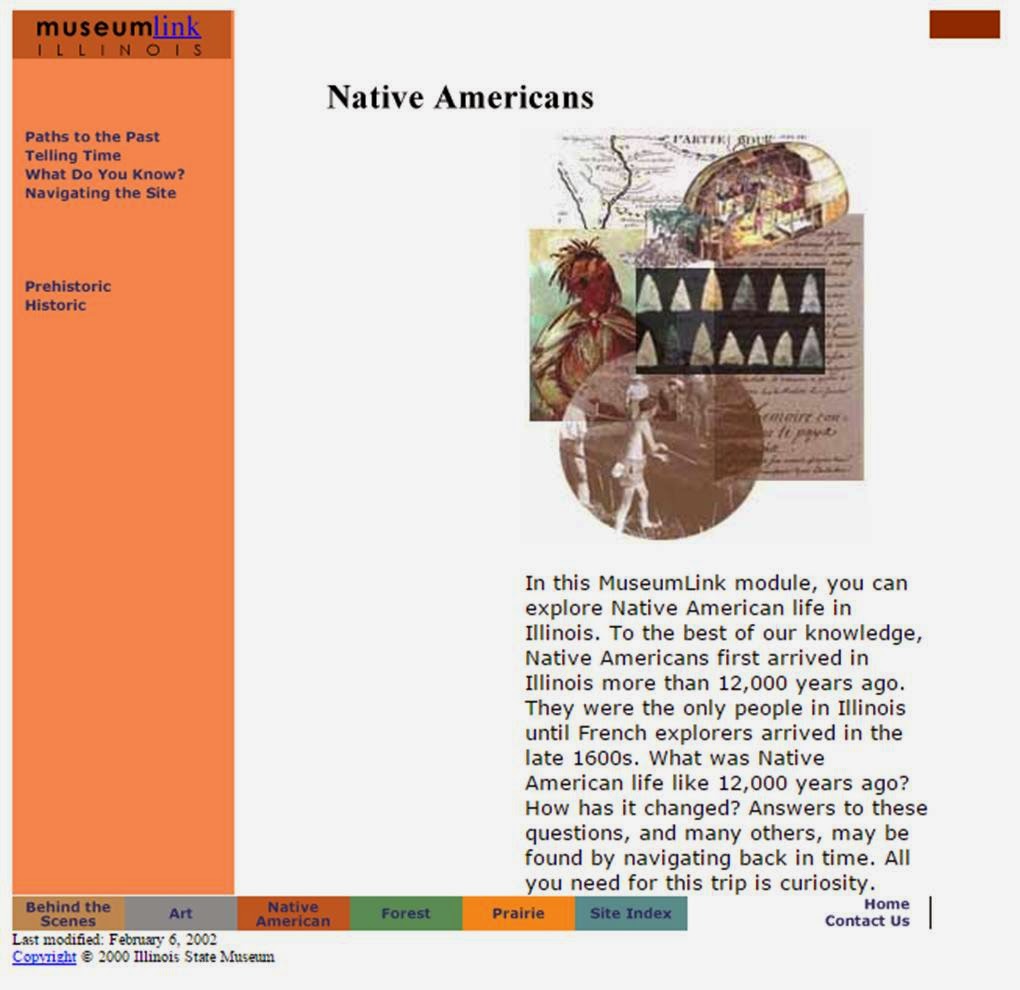
"In this MuseumLink module, you can explore Native American life in Illinois. To the best of our knowledge, Native Americans first arrived in Illinois more than 12,000 years ago. They were the only people in Illinois until French explorers arrived in the late 1600s. What was Native American life like 12,000 years ago? How has it changed? Answers to these questions, and many others, may be found by navigating back in time. All you need for this trip is curiosity."

Paths to the Past

Telling Time
Relative vs. Absolute Dating Methods.

What Do You Know About Native American History?
Debunking common stereotypes.

Prehistoric
Clovis points, Kimmswick, Missouri (left)and St. Clair County, Illinois (right). Image Courtesy of museumlinkIllinois.
Clovis points, Kimmswick, Missouri (left)and St. Clair County, Illinois (right).
Image Courtesy of museumlinkIllinois.
  • Paleoindian
    • Identity
    • Environment
      • Climate
      • Plants
      • Animals
    • Economy
      • Clothing
      • Food
      • Settlement
      • Trade
    • Technology
      • Tools & Utensils
      • Containers
      • Weapons
      • Shelter
      • Transportation
    • Society
    • Beliefs
    • Prehistoric sandal from Salts Cave, Kentucky. (ISM RoI 16, p. 28). Image Courtesy of museumlinkIllinois.
      Prehistoric sandal from Salts Cave, Kentucky. (ISM RoI 16, p. 28).
       Image Courtesy of museumlinkIllinois.
    • Archaeological Sites
  • Archaic
    • Identity
    • Environment
      • Climate
      • Plants
      • Animals
    • Economy
      • Clothing
      • Food
      • Settlement
      • Trade
    • Technology
      • Shelter
      • Tools & Utensils
      • Containers
      • Weapons
      • Transportation
    • Society
    • Beliefs
    • Archaeological Sites
Map of Illinois showing locations of Woodland sites. Image Courtesy of museumlinkIllinois.
Map of Illinois showing locations of Woodland sites.
Image Courtesy of museumlinkIllinois.
  • Woodland
    • Identity
    • Environment
      • Climate
      • Plants
      • Animals
    • Economy
      • Clothing
      • Food
      • Settlement
      • Trade
    • Technology
      • Shelter
      • Tools & Utensils
      • Containers
      • Weapons
    • Society
    • Beliefs
    • Archaeological Sites
Close-up of wood charcoal from a 8,500 year old campfire. Partially burned bits of plant material such as wood, seeds, and nutshell provide evidence of past environments and the types of plants used by people. Image Courtesy of museumlinkIllinois.
Close-up of wood charcoal from a 8,500 year old campfire.
Partially burned bits of plant material such as wood, seeds, and nutshell
provide evidence of past environments and the types of plants used by people.
Image Courtesy of museumlinkIllinois.

  • Mississippian
    • Identity
    • Environment
      • Climate
      • Plants
      • Animals
    • Economy
      • Clothin
      • Food
      • Settlement
      • Trade
    • Technology

    • Society
    • Beliefs
    • Archaeological Sites
Artist's illustration of an attack on a Protohistoric Oneota village.    Residents of the Morton site in Fulton County were subjected to raids periodically. The reasons for conflict are not clear. Image Courtesy of museumlinkIllinois.
Artist's illustration of an attack on a Protohistoric Oneota village.
Residents of the Morton site in Fulton County
were subjected to raids periodically. The reasons for conflict are not clear.
Image Courtesy of museumlinkIllinois.

  • Late Prehistoric
    • Identity
    • Environment
      • Climate
      • Plants
      • Animals
    • Economy
      • Clothing
      • Food
      • Settlement
      • Trade
    • Technology
      • Shelter
      • Tools & Utensils
      • Containers
      • Weapons
      • Transportation
    • Society
    • Beliefs
    • Archaeological Sites
  • Glossary
  • Activities and Resources
    • Pictionary with the Past
    • Mississippian Regalia
    • Mississippian Gorget
    • Pottery-making Methods
    • Falcon Dancer Mask
    • Additional Readings
      • Culture History
      • Regional Studies
      • Additional Readings
  • Teacher Orientation
    • Scope of the Module
    • Objectives
    • Reading Level
    • Resources for Teachers
    • Navigation
    • Content

Historic
Detail from "Carte de la Louisiane et du cours du Mississipi" (map by Guillaume Delisle, 1718) "Our Illinois [Indians] inhabit a very pleasant country. . . . the great rivers which water it, the vast and dense forests, the delightful prairies, the hills covered with very thick woods, --all these features make a charming variety." (Gabriel Marest, 1712). Image Courtesy of museumlinkIllinois.
Detail from "Carte de la Louisiane et du cours du Mississipi"
(map by Guillaume Delisle, 1718)
 "Our Illinois [Indians] inhabit a very pleasant country. . . .
the great rivers which water it, the vast and dense forests,
 the delightful prairies, the hills covered with very thick woods,
--all these features make a charming variety."
(Gabriel Marest, 1712). Image Courtesy of museumlinkIllinois.

"To paraphrase Mark Twain, rumors of our extinction are greatly exaggerated. Tribal members are active in promoting economic development, cultural and historical preservation, education, and health care programs for tribal members and other Indian people." (Steve Kinder, Peoria Tribe of Indians of Oklahoma, 1999). Image Courtesy of museumlinkIllinois.
"To paraphrase Mark Twain, rumors of our extinction are greatly exaggerated.
Tribal members are active in promoting economic development,
cultural and historical preservation, education,
and health care programs for tribal members and other Indian people."
(Steve Kinder, Peoria Tribe of Indians of Oklahoma, 1999).
Image Courtesy of museumlinkIllinois.
  • The Illinois Indians
    • Identity
      • Language
      • Territory
      • Appearance
    • Economy
      • Food
      • Settlements
      • Trade
      • Division of Labor
    • Technology
      • Houses
      • Tools and Utensils
      • Containers
      • Weapons
      • Transportation
      • European Trade
    • Society
      • Family
      • Leaders
      • Warfare
      • Social Status
      • Recreation
      • Neighbors
    • Beliefs
      • Religion
      • Calumet
      • Health
      • Death
      • Folklore
    • Art and Music
      • Art
      • Music
    • History
      • European Contact
      • Exploration
      • Fur Trade
      • The Illinois Decline
      • The Illinois Today
    • Archaeology
      • Illinois Villages
      • Zimmerman Site
      • Starved Rock Site
      • River L'Abbe Mission
      • Waterman Site
      • Ancestors
    • How Do We Know?
      • Written Records
      • Archaeology
  • Glossary
  • Activities and Resources
    • Comparison of Political Life
    • Dye Plants
    • Interview with Native American Teen
    • Movie of Native American Teen Dancing
    • Model Wigwam
    • Plum-stone Dice Game
    • Predicting the Past
    • Someone's in the Kitchen
      • Native American Recipes
    • BSA Indian Lore Merit Badge
    • Additional Readings
      • Sorted by section
      • Alphabetical bibliography
      • Websites of Interest
  • Teacher Orientation
    • Objectives of the Module
    • Reading Level
    • Resources for Teachers
    • Navigation
    • Content

For more information,
Visit:

Monday, March 30, 2015

Meet Native America: Natalie Standingontherock Proctor, Tribal Chairwoman, Wild Turkey Clan, Cedarville Band of Piscataway Conoy

Meet Native American. The National Museum of the American Indian.

"In the interview series Meet Native America, the Smithsonian National Museum of the American Indian invites tribal leaders, cultural figures, and other interesting and accomplished Native individuals to introduce themselves and say a little about their lives and work. Together, their responses illustrate the diversity of the indigenous communities of the Western Hemisphere, as well as their shared concerns, and offer insights beyond what’s in the news to the ideas and experiences of Native peoples today." 
-Dennis Zotigh, NMAI 

Natalie StandingontherockProctor, tribal chairwoman, Wild Turkey Clan, Cedarville Band of Piscataway Conoy. Annapolis, Maryland, January 2012. Image Courtesy of the National Museum of the American Indian's Blog.
Natalie StandingontherockProctor, tribal chairwoman,
Wild Turkey Clan, Cedarville Band of Piscataway Conoy.
Annapolis, Maryland, January 2012.
Image Courtesy of the National Museum of the American Indian's Blog.


"Where is your community located? Where are your people originally from?

The Piscataway's original territory covered what became colonial Maryland, which included present-day Washington, D.C., parts of Virginia—Fairfax County, Loudon County, etc.—and West Virginia, and some of Pennsylvania. The majority of Piscataway people now live in Washington and the southern part of Maryland, in the counties of Prince George and Charles. "

Friday, March 27, 2015

National Park Service's Indigenous Cultural Landscape

Video Courtesy of the National Park Service.

National Park Service's American Indian Program Manager, Deanna Beacham, discusses how the National Park Service's initiative of Indigenous Cultural Landscape began and evolved from protecting lands in Executive Order 13007 into a "methodology and criteria for identifying and representing indigenous cultural landscapes for the purposes of conservation and interpretation"*.

"This construct recognizes and respects that Indian cultures lived within the context of their environment, although not in the stereotypical sense of “living in harmony with the environment.” American Indian peoples lived around major waterways within large, varied landscapes, with which they were intimately familiar. They used different parts of those landscapes in different ways: for food, medicine, and clothing procurement, for making tools and objects related to transportation and the household, for agriculture, and for settlements."
A Model for Conservation, Interpretation, and TourismGeorge Wright Society Conference on Parks,
 Protected Areas, and Cultural Sites, 2011.

For more information,
Visit:

Thursday, March 26, 2015

Meet Native America: Donald Wanatee, Council Member, Sac and Fox Tribe of the Mississippi in Iowa

Meet Native American. The National Museum of the American Indian.

"In the interview series Meet Native America, the Smithsonian National Museum of the American Indian invites tribal leaders, cultural figures, and other interesting and accomplished Native individuals to introduce themselves and say a little about their lives and work. Together, their responses illustrate the diversity of the indigenous communities of the Western Hemisphere, as well as their shared concerns, and offer insights beyond what’s in the news to the ideas and experiences of Native peoples today." 
-Dennis Zotigh, NMAI 

Donald Wanatee, Sac & Fox Tribal Council member. Photo courtesy of the Sac & Fox Tribe of the Mississippi in Iowa/Meskwaki and the National Museum of the American Indian's Blog.
"Where is your community located? Where are your people originally from?

The Sac and Fox—the Meskwaki—originated along the St. Lawrence in southern Canada, near Montreal and Three Rivers. To get here I surmise was quite a march for our people. After running around from government troops, we settled in Tama County, Iowa. We, the tribe, in the year 1857 bought 80 acres of land along the Iowa River, which we eventually expanded to 10,000 acres, thus increasing the legitimacy of our land holdings and governmental structure. A so-called "self-governing" tribe, we should have been given instruction in "self-government." Receiving no guidance from federal lawmakers, we stand."

Wednesday, March 25, 2015

New Statehouse Gavels Made from Newark Earthworks Tree

"Miami Tribe of Oklahoma member Jody Gamble made the small ceremonial gavels
using wood from a North American red oak tree believed to have been at least 225 years old.
They were presented to the Ohio Legislature in honor of Statehood Day."
Image and Caption Courtesy of Miami University.
March, 4, 2015.
Emily Maddern, of the Newark Advocate, has written an interesting article about the recent gift of ceremonial gavels to the Ohio Legislature in celebration of Statehood Day
by the Miami Tribe of Oklahoma and the Ohio History Connection.

"George Ironstrack, a member of the Miami Tribe of Oklahoma, said the man who carved the gavel was honored to not only be involved in the project but to have the Ohio History Connection recognize Ohio is a part of the tribe’s homelands and what a powerful symbol the red oak tree was.
“Our people aren’t mound builders, but Ohio is the landscape that our people lived on and we traveled through,” Ironstrack said. “The tree kind of symbolizes the rootedness, the connectedness to a place for lots of different people who have called Ohio home over time and a shared desire to protect those places.” "

To read the full articleclick here.

For more information,
Visit:

Tuesday, March 24, 2015

myaamiaki iši meehtohseeniwiciki: How the Miami People Live

myaamiaki iši meehtohseeniwiciki: How the Miami People Live

"This website is one part of a grant awarded by the Institute of Museum and Library Services to the Miami Tribe of Oklahoma. It is intended to give a thorough review of the myaamiaki iši meehtohseeniwiciki exhibition that was housed at the Miami University Art Museum from September 16th to December 13th 2008. You will find a interactive walkthrough of the exhibit as it was, including close up images of most of the objects. Be sure to click the text on the walls for more information on the exhibit, as well as important quotes by Myaamia people. Visit the 'Auditorium' for videos of the opening events, sculpture dedication, and lecture series that happened during the exhibition's run.

Also featured on the website is a browsable list with pictures of each item, a slideshow of images from the opening events, and links to organizations related to this project."

eekootoonkia (Exhibit)
Adobe Flash walkthrough of the individual pieces and installation of the exhibit.

kaakisitoonkia (Preserved Objects)
Searchable by Objects and Quotes with descriptions, date, image, and loaning institution.

atakohkana (Links)

  • Loaning Institutions
    • University of Pennsylvania Museum of Archaeology and Anthropology
    • The Lilly Library, Indiana University
    • Indiana Historical Society
    • Garst Museum
    • Tippecanoe County Historical Association
    • George Adams Gallery
    • Kansas City Museum
    • National Museum of the American Indian
    • Cranbrook Institute of Science
    • Wabash County Historical Museum
    • Detroit Institute of Arts
    • Darke County Park District
    • Library of Congress
    • Miami University
    • Atwater Kent Museum of Philadelphia
    • Chicago History Museum
    • Detroit Historical Society
For More Information,
Visit:

Monday, March 23, 2015

Meet Native America: Scott N. BigHorse, Assistant Principal Chief, Osage Nation

Meet Native American. The National Museum of the American Indian.

"In the interview series Meet Native America, the Smithsonian National Museum of the American Indian invites tribal leaders, cultural figures, and other interesting and accomplished Native individuals to introduce themselves and say a little about their lives and work. Together, their responses illustrate the diversity of the indigenous communities of the Western Hemisphere, as well as their shared concerns, and offer insights beyond what’s in the news to the ideas and experiences of Native peoples today." 
-Dennis Zotigh, NMAI 


Assistant Principal Chief Scott N. BigHorse. Photo courtesy of the Osage Nation and the National Museum of American Indian's Blog.
Assistant Principal Chief Scott N. BigHorse.
Photo courtesy of the Osage Nation and the National Museum of American Indian's Blog.
"Where is your nation located?
Wa Zha Zhe (Osage), Oklahoma. Wa ka Ko LiN (Pawhuska) is the capital.

Where was your tribe originally from?
The Ohio Valley to the St. Louis, Missouri, area."

Friday, March 20, 2015

Canadian First Nations Seek to Protect Forest Homeland

February, 24, 2015.
Edwin Dobb, of National Geographic, has written an informative article about the recent efforts of several First Nations of Canda to preserve and protect their ancestral land and are part of the "truth and reconcilliation process" with Canada's government.

"But becoming part of a global campaign wasn't on the minds of Sophia Rabliauskas and other Poplar River leaders when they started trying to reclaim the place they simply call the "bush."

Their aim was as simple as it was bold—to become the guardians of their traditional territory. To that end they created a land management and conservation plan while recruiting their First Nations neighbors to join them in what has been a decades-long endeavor.

Eventually, in 2011, the provincial government relented, giving the Poplar River First Nation control over an area known as the Poplar/Nanowin Rivers Park Reserve.

The reserve, home to most of the band's 1,700 members, covers only 3,800 acres, but the Poplar River First Nation's historic territory stretches eastward from the lake almost to the Ontario border—about two million acres of lowland forest and bog, or muskeg, that the provincial government officially considered unoccupied as recently as the 1990s."

To read the full articleclick here.

For more information,
Visit:

Thursday, March 19, 2015

Meet Native America: Cara Cowan Watts, Cherokee Nation Tribal Council

Meet Native American. The National Museum of the American Indian.

"In the interview series Meet Native America, the Smithsonian National Museum of the American Indian invites tribal leaders, cultural figures, and other interesting and accomplished Native individuals to introduce themselves and say a little about their lives and work. Together, their responses illustrate the diversity of the indigenous communities of the Western Hemisphere, as well as their shared concerns, and offer insights beyond what’s in the news to the ideas and experiences of Native peoples today." 
-Dennis Zotigh, NMAI 


Cara Cowan Watts (right) and Christy Kingfisher at the Cherokee National Holiday Powwow. Talequah, Oklahoma, 2012. Image Courtesy of Cara Cowan Watts and the National Museum of the American Indian's Blog.
"Where is your nation located? 

The Cherokee Nation is located in all or part of 14 counties in northeastern Oklahoma, and our tribal jurisdiction (which is not a reservation) is approximately 7,000 square miles. I live in Rogers County. The tribe’s capital is Tahlequah, Oklahoma, which is in Cherokee County and more than one hour from Rogers County. All of Cherokee, Sequoyah, Adair, Nowata, Craig, and Mayes counties are within the Cherokee Nation, and a portion of Delaware, Rogers, Ottawa, McIntosh, Muskogee, Tulsa, Wagoner and Washington counties are within the Cherokee Nation.

Where was your nation originally from?

Cherokee lands included parts of West Virginia, Virginia, Kentucky, Tennessee, Alabama, Georgia, North Carolina, and South Carolina. Today, only three Cherokee governments remain: the Cherokee Nation, Eastern Band of Cherokee Indians, and United Keetoowah Band of Cherokee Indians. "

Wednesday, March 18, 2015

Alligators and Groundhogs

"LiDAR image of the Raccoon Creek valley centered on Alligator Mound.  The blue line shows the cross-quarter winter sunsets/summer sunrises axis"   Image Courtesy of the Ohio History Connection Archaeology Blog.
"LiDAR image of the Raccoon Creek valley centered on Alligator Mound.
The blue line shows the cross-quarter winter sunsets/summer sunrises axis"
Image Courtesy of the Ohio History Connection Archaeology Blog.
February, 2, and February 5, 2015.
Jeff Gill, published by the Ohio History Connection Archaeology Blog, has written a two series post about the potential celestial alignments of the Alligator Mound at astronomical cross-quarter days.

"Along with those four points at the equinoxes and solstices, there’s a secondary four that has a fair amount of cross-cultural resonance. You hear a hint of it in “Midsummer’s Day” being June 20 or 21, which is astronomically what we call the “first” day of summer in modern America.

The midpoints of those first four, or Quarter days, are called Cross-quarter days."

To read the full postclick here.

"The protruding ridge where Alligator Mound is built at the end is the only place I can find in all of the Licking County region where you would have the “projection screens” at the right locations, enough vertical to the ENE & WSW to have these dancing shadow giants appear for a few moments just before sunset or right after sunrise.

Come May 3, I’ll be up atop this spot, now just before dawn, hoping to get some good film of the “Alligator Hill effect” against the side of Mount Parnassus, the isolated hill to the WSW. Maybe I’ll see you there!"

To read the full postclick here.

For more information,
Visit:

Tuesday, March 17, 2015

Online Resources for Teachers

This list is not by any means complete and any views expressed in the links below
 are meant to inform; not to represent the viewpoints of the Newark Earthworks Center 
or the Ohio State University.

Remember to check out our Archive Sources Tag
for more detailed analysis and potential sources of primary documentation.

The Eastern Shawnee Tribe of Oklahoma's 2013 visit to the Newark Earthworks for a World Heritage Celebration.
The Eastern Shawnee Tribe of Oklahoma's 2013 visit
 to the Newark Earthworks for a World Heritage Celebration.
For information about a specific Nation's traditions, 
please remember to contact them directly 
for recommendations and suggestions. 


Our available field trips, summer camp opportunities, and school outreach programs.

Helpful Links
Lesson Plans
Online Exhibits
Videos
  • Midwest Native & Earthworks Video Tab
  • The Chickasaw Nation.TV
  • The Archaeological Channel
  • In the Light of Reverence
    • Sacred Land Film Project, 2001.
    • "explores American culture’s relationship to nature in three places considered sacred by native peoples: the Colorado Plateau in the Southwest, Mount Shasta in California, and Devils Tower in Wyoming. Rich in minerals and timber and beloved by recreational users, these “holy lands” exert a spiritual gravity which pulls Native Americans into conflicts with mining companies, New Age practitioners, and rock climbers. Ironically, all sides see themselves as besieged. Their battles tell a new story of culture clashes in an ancient landscape"
  • Mysteries of the Ancient Architects
    • Hopewell Culture National Historical Park, 2012.
    • The Archaeology Channel, short clip.
    • "Beginning over 2000 years ago, enormous  Glossary Link earthworks were built along Ohio’s Scioto River, all constructed on a grand scale with intriguing precision. Many were designed as combinations of giant geometric squares, circles, and octagons. Amazingly, the earthworks seem to adhere to a master architectural design, the earthen signature of a bygone culture. We will never know what these people called themselves, but today the ancient builders are known to archaeologists as the Hopewell Culture. These people had neither towns nor villages. But they did have big ideas and advanced understandings of geometry and astronomy to carry them out. The mysteries persist. Yet, here, we find a tantalizing glimpse into a way of life that resulted in monuments of earth that challenge the imagination."
  • National NAGPRA Youtube
  • Ojibwe Waasa-Inaabidaa, "We Look in All Directions"
    • "Over three years in the making, this comprehensive six-part documentary series covers 19 Ojibwe Bands in three states and spans over 500 years of Ojibwe history and culture"
  • Public Broadcasting Station (PBS)
  • The Sun Dagger
    • Solstice Project, 1983.
    • "More than a thousand years ago, the Anasazi, in Chaco Canyon, New Mexico, set three slabs of stone at the top of Fajada Butte and inscribed two spirals on the rockface below. The positioning of the slabs produces daggers of light on the spirals that indicate the first day of winter, spring, summer, and autumn. The way light falls on the large spiral at moonrise also indicates the progress of the 19-year cycle of the Moon. The perfect meeting of the Sun, the Moon, the Earth, and Time."
  • Teaching Rocks
    • Lloyd Walton, 1987.
    • Vimeo
    • "A visually arresting film, concentrates on the native art of the Ojibwa tribe. Much Ojibwa history and philosophy has been related through the rock carvings and paintings which are featured throughout this work. The voices of the Elders are heard in the film, describing the tales of creation and existence that mark the group's iconography. A sense of mystery informs this evocative film as the realization strikes that no individual can expect to penetrate the mythos of the Ojibwa."
  • We Shall Remain: America Through Native Eyes
    • PBS, 2009.
    • "They were charismatic and forward thinking, imaginative and courageous, compassionate and resolute, and, at times, arrogant, vengeful, and reckless. For hundreds of years, Native American leaders from Massasoit, Tecumseh, and Tenskwatawa, to Major Ridge, Geronimo,
    • and Fools Crow, valiantly resisted expulsion from their lands and fought the extinction of their culture. Sometimes, their strategies were militaristic, but more often they were diplomatic, spiritual, legal, and political.
      From PBS s acclaimed history series, American
      Experience, in association with Native American Public Telecommunications, We Shall Remain establishes Native history as an essential part of American history. These five documentaries spanning three hundred years tell the story of pivotal moments in U.S. history from the Native American perspective, upending two-dimensional stereotypes of American Indians as simply ferocious warriors or peaceable lovers of the land."

Monday, March 16, 2015

Archaeology: Theory Looks at How Ancient Goods Got to Ohio

The Hopewell Interaction Sphere.  Image Courtesy of Voyageur Media Group  and the Ohio History Connection Archaeology Blog.
The Hopewell Interaction Sphere.
Image Courtesy of Voyageur Media Group
and the Ohio History Connection Archaeology Blog.
February, 15, 2015.
Brad Lepper, of the Ohio History Connection Archaeology Blog, has written a blog post and an article in The Columbus Dispatch about new details in how Ohio's Hopewell Culture, 100 B.C - A.D. 400, received their exotic material artifacts.

"We call it an Interaction Sphere, because we don’t know for sure what’s behind all the interaction and we don’t want to presume the answer to our question by calling it, for example, a trade network – although trade most certainly was at least one part of what was going on. Interaction Sphere is a convenient and descriptive yet neutral term to apply to the widespread movement of ideas and materials that is so characteristic of the Middle Woodland period in Ohio and other regions in eastern North America."

To read the full postclick here.

"Those exotic materials include Canadian copper, Gulf Coast sea shells, Wyoming obsidian and North Carolina mica. Figuring out how and why this eye-catching stuff made its way to Ohio is among the most fascinating questions in American archaeology."


To read the full articleclick here.

For more information,
Visit:
*Link provided requires a sign in to Project Muse
Ohio State University students can use their student log-in to access the database

Friday, March 13, 2015

Legends in the Land: The Importance and Preservation of Tribal Storytelling

Timm Whissen

Dr. John Low lecturing on The Pokagon Band of Potawatomi Indians- Survival and Revival Through Storytelling, February 25, 2015. Image Courtesy of Timothy E. Black, DMIN Photography.
Dr. John Low lecturing on The Pokagon Band of Potawatomi Indians- Survival and Revival Through Storytelling, February 25, 2015. Image Courtesy of Timothy E. Black, DMIN Photography.
Dr. John Low, Assistant Professor of Comparative Studies at the Ohio State University Newark Campus and member of the Pokagon Band of Potawatomi gave the closing lecture on Wednesday, February 25th for the Newark Earthworks Center sponsored lecture series entitled: “Returning to the Earthworks”.

He discussed the importance of storytelling for both his tribe and for people everywhere. They are a way of conveying customs and language, history and identity to descendants and to those who are invited to listen.

Dr. Low emphasized that as listeners they do not tell others that their stories are wrong, “stories feed us, they nurture us and they keep us alive. So we share those stories”.

In one brief account, Dr. Low mentions the sweat lodge and the Longhouse he knew of growing up. Within the fire of the lodge were four circles, representative of; The Mammoth people or Paleo-Indians, the Adena culture, the Hopewell culture, and the Potawatomi. The circles are a celebration of the connection between these groups and the land.

This connection is one example of why storytelling, in all of its forms, is important to American Indians. Earthworks are one of many ways in which stories are told, like songs, scrolls, or ledger art, they symbolize important cultural details and must be preserved in order to be passed on.

As a member of the closest federally recognized tribe to the ancient Earthworks here in central Ohio, Dr. Low feels that maintaining a connection to the ancestors who had built the Earthworks, and the mounds themselves, is important for their identity and also for preserving the Earthworks both in meaning and in form.

Tribal support in recent years has helped the Newark Earthworks Center in seeking World Heritage Status for many of Ohio’s ancient structures, including the Great Circle and Octagon Mound here in Newark.

The importance of being listed as an UNESCO World Heritage site is great.

It would garnish international support in the preservation of these sites and provide additional economic advantages, such as a boost in tourism which would benefit the mounds and the local community greatly.

He concluded by discussing the importance of community support in finding a way to preserve the earthworks in a fashion more representative of what we think the mounds were originally intended for; as a public space where people can come together.

“Stories are created from experiences”. Many are lost and may not be able to be reclaimed, but there should be no reason why we cannot create stories here in the present.

Even collaboration with the current and divisive land lease holders of the Octagon Mound, the Mound builders Country Club, would help in preserving the Earthworks until they could be respectively returned to the community as a place to share and inspire.

Ultimately, preservation of the Earthworks is dependent on help from many groups. Working together will help in ensuring that the mounds, and their stories, remain intact for future generations.

For more information,
Visit:
Publications Include
* Links provided require a sign in to Project Muse
Ohio State University students can use their student log-in to access the database

Thursday, March 12, 2015

Meet Native America: Lisa Johnson-Billy, Oklahoma Representative for District 42

Meet Native American. The National Museum of the American Indian.

"In the interview series Meet Native America, the Smithsonian National Museum of the American Indian invites tribal leaders, cultural figures, and other interesting and accomplished Native individuals to introduce themselves and say a little about their lives and work. Together, their responses illustrate the diversity of the indigenous communities of the Western Hemisphere, as well as their shared concerns, and offer insights beyond what’s in the news to the ideas and experiences of Native peoples today." 
-Dennis Zotigh, NMAI 


Oklahoma Representative Lisa Johnson-Billy (Chickasaw and Choctaw).  Photo Courtesy of the Oklahoma State Capitol  and the National Museum of the American Indian Blog.
Oklahoma Representative Lisa Johnson-Billy (Chickasaw and Choctaw).
 Photo Courtesy of the Oklahoma State Capitol
and the National Museum of the American Indian Blog.
"Please introduce yourself with your name and title.
Lisa Johnson-Billy, Oklahoma representative for district 42.

What tribes are you affiliated with?
...
Are there any other Natives who are elected leaders in your state?
Yes, there are other Native Americans who serve in the legislature. In fact, nearly 10 years ago, Rep. Paul Wesselhoft (Citizen Potawatomi) and I set up the first Oklahoma Native American Caucus. As we began the process of developing the caucus, then-member Shane Jett, a Cherokee citizen, eagerly jumped on board, and together we developed by-laws and elected chairmen. I served as the first co-chairman. We designed the caucus to be bipartisan, in that we always elect one chairman who is a Republican and one who is a Democrat. Our original goals included developing better relationships with our tribal governments and leaders. We also assisted House and Senate members in knowing which tribe or tribes live in their districts. The caucus has accomplished these goals and has passed several pieces of significant legislation, including a tribal law enforcement bill and a tribal language bill. We also created a tribal liaison position with the governor's leadership team. The caucus has about twenty members with most of those holding Certificate of Degree of Indian Blood (CDIB) cards."

To read the full interview, click here.

For more information, 
Visit: