Thursday, January 28, 2016

How Far Did Hohokam Reach? Researcher Thinks They Dominated Southwest for Centuries

The Salado built the dwellings preserved by Tonto National Monument,  but at least one researcher believes they were part of a regional civilization dominated by the Hohokam.  Image Courtesy of  Payson Roundup.
The Salado built the dwellings preserved by Tonto National Monument,
but at least one researcher believes they were part of a regional civilization dominated by the Hohokam.
Image Courtesy of  Payson Roundup.
December 29, 2015.
Pete Aleshire, of Payson Roundup, has written an informative article about Dr. Steven Shackley's recent analysis of the sources of Hohokam culture linked obsidian. The Hohokam culture, from AD 200 - AD 1400, was an influential civilization based mostly along the Gila and Salt Rivers
 in present-day central and southern Arizona in the United States.

"The work gives added stature to the to Hohokam, whose importance has long been overshadowed by the much more durable and impressive ruins left by the Ancestral Puebloeans — previously referred to as the Anasazi. They built great cliff houses, with complexes of giant, round, half-buried, ceremonial kivas in places like Chaco Canyon and Mesa Verde.
The Hohokam built mostly adobe and earthen cities along rivers and extensive irrigation systems they built along those rivers — especially the Salt, Verde and Gila rivers, which converge in the Valley. In addition to the massive irrigation works, the Hohokam built great, raised, platform mound housing for their elites and not entirely understood “ball courts,” reminiscent of the structures of the Mayans and Aztecs."

To read the full articleclick here.

For more information,
Visit:

Wednesday, January 27, 2016

Summer Research Opportunities Program (SROP) at The Ohio State University

May 24, 2016 - July 30, 2016.
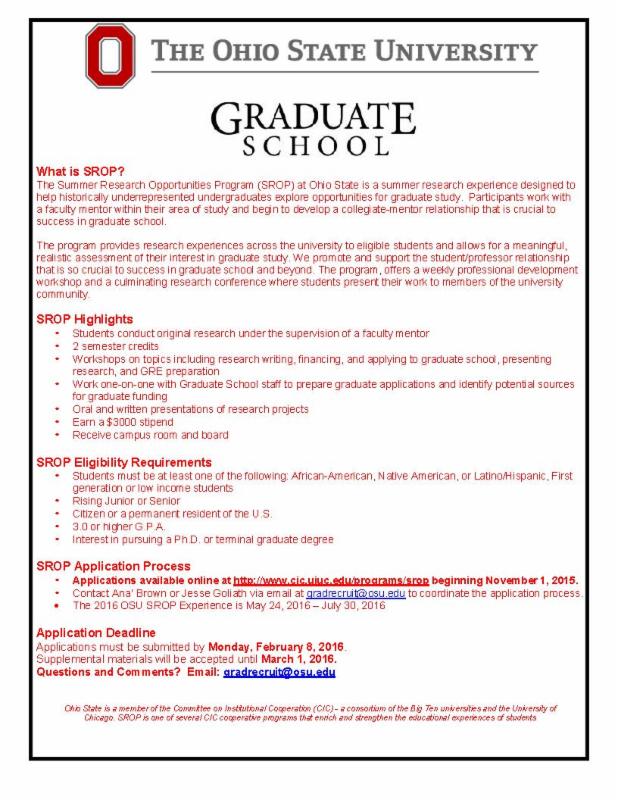
What is SROP?
The Summer Research Opportunities Program (SROP) at Ohio State is a summer research experience designed to help historically underrepresented undergraduates explore opportunities for graduate study. Participants work with a faculty mentor within their area of study and begin to develop a collegate-mentor relationship that is crucial to success in graduate school.

The program provides research experiences across the university to eligible students and allows for a meaningful, realistic assessment of their interest in graduate study. We promote and support the student/professor relationship that is so crucial to success in graduate school and beyond. The program offers a weekly professional development workshop and a culminating research conference where students present their work to members of the university community.

SROP Highlights
  • Students conduct original research under the supervision of a faculty mentor
  • 2 semester credits
  • Workshops on topics including research writing, financing, and applying to graduate school, presenting research, and GRE preparation
  • Work one-on-one with Graduate School staff to prepare graduate applications and identify potential sources for graduate funding
  • Oral and written presentations of research projects
  • Earn a $3000 stipend
  • Receive campus room and board

SROP Eligibility Requirements
  • Students must be at least one of the following: African-American, Native American, or Latino/Hispanic, First generation or low income students
  • Rising Junior or Senior
  • Citizen or a permanent resident of the U.S.
  • 3.0 or higher G.P.A.
  • Interest in pursuing a Ph.D. or terminal graduate degree

SROP Application Process
  • Applications available online at https://www.cic.net/students/srop/introduction beginning November 1, 2015.
  • Contact Ana'Brown or Jesse Goliath via email at gradrecruit@osu.edu to coordinate the application process.
  • The 2016 OSU SROP Experience is May 24, 2016- July 30, 2016.

Application Deadline
Applications must be submitted by Monday, February 8, 2016.
Supplemental materials will be accepted until March 1, 2016.
Questions and Comments? Email: gradrecruit@osu.edu .

Ohio State is a member of the Committee on Institutional Cooperation (CIC)- a consortium of the Big Ten universities and the University of Chicago. SROP is one of several CIC cooperative programs that enrich and strengthen the educational experiences of students.

Tuesday, January 26, 2016

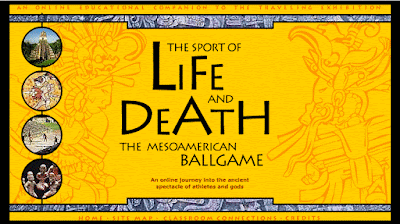
The Sport of Life and Death: The Mesoamerican Ballgame

The Sport of Life and Death: The Mesoamerican Ballgame. An online journey into the ancient spectacle of athletes and gods.

"An online educational companion to the traveling exhibition."
Explore World
  • Map and Timeline
    • Map Today
    • 1500 BC-1519 AD
  • Cultures
    • Olmec
    • Western Mexico
    • Teotihuacan
    • Maya
    • Veracruz
    • Toltec
    • Huastec
    • Aztec
  • Artwork
  • Ballgame
  • Site
Explore Game
  • The Ball
  • The Uniform
    • Yuguito
    • Yoke
    • Hacha
    • Palma
    • Manopla
    • See a parade of players
    • Learn about their team mascots
    • Visit the players' locker room
  • The Court
    • Walk Around a Court
    • Listen to an ancient Aztec Song
    • See a gallery of artwork from the courts
    • What can we learn from this ancient vessel?
  • The Game
    • Watch a game
    • How we play the game
    • What happened to the users?
    • Did women play?
Experience Game
  • Watch
    • Hear commentary
    • See more of this model
      • Side view
      • Top view
      • Spectators
      • Drummers
      • Players
  • Play
    • "Today you have a game against your rivals, the Deer. You can lead the Jaguars to victory through your knowledge of the Mesoamerican world. For every question you answer correctly, your team scores 1 point. Every time you miss a question, you drop the ball for your team and the Deer score a point. The First Team to 5 Points Wins!"
Experience Exhibit
Classroom Connections
  • Make a paper face mask
    • Visual arts, social studies, and math
    • Grades 3-5
  • Create a clay effigy vessel
    • Visual arts, social studies, language arts, and science
    • Grades 3-5
  • Craft headdress & costumes from paper
    • Visual arts and social studies
    • Grades 6-12
  • Mold clay ballgame figurines
    • Visual arts and social studies
    • Grades 3-12

Thursday, January 21, 2016

Meet Native America: Honorable Eric Robinson, Deputy Premier of Manitoba and Minister of Aboriginal and Northern Affairs

Meet Native American. The National Museum of the American Indian.

"In the interview series Meet Native America, the Smithsonian National Museum of the American Indian invites tribal leaders, cultural figures, and other interesting and accomplished Native individuals to introduce themselves and say a little about their lives and work. Together, their responses illustrate the diversity of the indigenous communities of the Western Hemisphere, as well as their shared concerns, and offer insights beyond what’s in the news to the ideas and experiences of Native peoples today." 
-Dennis Zotigh, NMAI 

Deputy Premier Robinson at the Aboriginal Peoples Choice Music Awards.  Manito Ahbee, Winnipeg, 2013. Image Courtesy of the National Museum of the American Indian's Blog.
Deputy Premier Robinson at the Aboriginal Peoples Choice Music Awards.
Manito Ahbee, Winnipeg, 2013.
Image Courtesy of the National Museum of the American Indian's Blog.
"How many bands are in Manitoba? Do you meet with the Native people of your province? 

There are 63 First Nations in the province:

Barren Lands First Nation, in Brochet, Manitoba
Berens River First Nation, Berens River 
Birdtail Sioux First Nation, Beulah 
Black River First Nation, O’hanley 
Bloodvein First Nation, Bloodvein 
Brokenhead Ojibway Nation, Scanterbury 
Buffalo Point First Nation, Buffalo Point 
Bunibonibee Cree Nation, Oxford House 
Canupawakpa Dakota First Nation, Pipestone 
Chemawawin Cree Nation, Easterville 
Cross Lake First Nation (Pimicikamak Cree Nation), Cross Lake 
Dakota Plains First Nation, Portage La Prairie 
Dakota Tipi First Nation, Dakota Tipi 
Dauphin River First Nation, Gypsumville 
Ebb and Flow First Nation, Ebb and Flow 
Fisher River Cree Nation, Koostatak 
Fort Alexander First Nation (Sagkeeng First Nation), Fort Alexander 
Fox Lake Cree Nation, Gillam 
Gamblers First Nation, Binscarth 
Garden Hill First Nation, Garden Hill 
God’s Lake First Nation, God’s Lake Narrows 
Hollow Water First Nation, Wanipigow 
Keeseekoowenin First Nation, Elphinstone 
Kinonjeoshtegon First Nation, Dallas 
Lake Manitoba First Nation, Lake Manitoba 
Lake St. Martin First Nation, Gypsumville 
Little Grand Rapids, Little Grand Rapids 
Little Saskatchewan First Nation, Gypsumville 
Long Plain First Nation, Portage la Prairie 
Manto Sipi Cree Nation, God’s River 
Marcel Colomb First Nation, Lynn Lake 
Mathias Colomb First Nation, Pukatawagan 
Misipawistik Cree Nation, Grand Rapids 
Mosakahiken Cree Nation, Moose Lake 
Nisichawayasihk Cree Nation, Nelson House 
Northlands First Nation, Lac Brochet 
Norway House Cree Nation, Norway House 
O-Chi-Chak-Ko-Sipi First Nation, Crane River 
Opaskwayak Cree Nation, Opaskwayak 
O-Pipon-Na-Piwin Cree Nation, South Indian Lake 
Pauingassi First Nation, Pauingassi 
Peguis First Nation, Peguis Reserve 
Pinaymootang First Nation, Fairford 
Pine Creek First Nation, Camperville 
Poplar River First Nation, Negginan 
Red Sucker Lake First Nation, Red Sucker Lake 
Rolling River First Nation, Erickson 
Roseau River Anishinabe First Nation, Ginew 
Sandy Bay First Nation, Marius 
Sapotaweyak Cree Nation, Pelican Rapids 
Sayisi Dene First Nation, Tadoule Lake 
Shamattawa First Nation, Shamattawa 
Sioux Valley Dakota, Griswold 
Skownan First Nation, Skownan 
St. Theresa Point First Nation, St. Theresa Point 
Swan Lake First Nation, Swan Lake 
Tataskweyak Cree Nation, Split Lake 
Tootinaowaziibeeng Treaty Reserve, Tootinaowaziibeeng 
War Lake First Nation, Ilford 
Wasagamack First Nation, Wasagamack 
Waywayseecappo First Nation Treaty Four, Waywayseecappo 
Wuskwi Sipihk First Nation, Birch River 
York Factory First Nation, York Landing 

Manitoba is also the home of an important Metis population. As minister and as member for Kewatinook, I meet with Indigenous people virtually every day. 

Do the Native people in Manitoba vote in provincial elections? 

Native people got the right to vote in 1960. "

To read the full interviewclick here.

Manitoba Aboriginal and Northern Affairs website.


Wednesday, January 20, 2016

People Roamed Tip of South America 18,500 Years Ago

November 30, 2015.
Bruce Bower, of ScienceNews, has written an interesting article about new radiocarbon dates for Monte Verde, Chile; one of the earliest known sites of human occupation within the Americas.
New finds have been dated to between 18,500 to 17,000 years ago.

"Archaeologists searching for further pre-Clovis sites will need to keep an eye out for simple tools and remnants of small hearths or campfires, Dillehay adds. Remains of Clovis sites, which typically feature separate areas for cooking, toolmaking and other activities, are easier to spot.

The discoveries at Monte Verde “point to a new kind of site that needs much more study” to understand when people first reached the Americas, remarks archaeologist Daniel Sandweiss of the University of Maine in Orono. "

To read the full articleclick here.

For more information,
Visit:

Tuesday, January 19, 2016

Law Library of Congress

Law Library of Congress
"In 1832, The Law Library of Congress was officially established to provide the United States Congress and Supreme Court with access to current and accurate legal research materials. Over time, our mission was expanded to include other branches of the U.S. Government, the public and the global legal community. This evolving mission is supported by a collection of more than 2.65 million volumes and brings together the expertise of approximately 100 lawyers, librarians, other professionals and support staff who provide legal reference, research and analysis using the Law Library’s collection, and also draw upon the collections and expertise of our colleagues throughout the Library of Congress.

The Law Library has grown over the years to become the world’s largest, with a collection that spans the ages and covers virtually every jurisdiction in the world. As the leading research center for foreign, comparative and international law, the Library also provides valuable reference assistance to the scholarly community and to law practitioners across the nation and the globe. While our name says “of Congress,” we are an intellectual asset that belongs to everyone!

The Law Library continues to be guided by the belief that universal access to and the understanding of law serves an important role in promoting peace and democracy. We are also committed to the fundamental principle that legal information must be accurate, authentic and authoritative."


Frequently Asked Questions
  • Photographs
  • Newspapers
  • Periodicals/Journals
  • Rare Books
  • Maps
  • Architectural Drawings
  • Microfilm
  • Art Prints & Illustrations
  • Manuscripts
  • Sheet Music & Musical Scores
  • General/Technical Books
  • Posters
  • Legal Documents
  • Commemorative Observances
  • Digitized Material
  • Legal Reports
  • Guide to Law Online
  • Guides to Our Collections
  • Legal Research Guides
Find Legal Resources
  • Recommended Resources by Topic (Available in PDF)
    • Adoption, Custody, and Parentage
    • Aeronautics and Space
    • Armed Forces
    • Constitutional Issues
    • Crime and Law Enforcement
    • Education, Family, and Children's Rights
    • Emergency and Disaster Relief
    • Immigration, Nationality, and Citizenship
    • Indigenous and Cultural Property
      • Destruction of Cultural Property
        • Cyprus.
      • Maori Culture and Intellectual Property Law
        • New Zealand.
      • Preservation of Historical Cemeteries
        • 19 countries; United States.
      • Repatriation of Historic Human Remains
        • Australia; New Zealand; United Kingdom.
    • Intellectual Property
      • Protection of Trade Secrets
        • Brazil; China; India; Russia; South Africa.
    • Marriage, Divorce, and Estates
      • Inheritance Laws in the 19th and 20th Centuries
        • France; Germany; United States; England and Wales.
    • Minority and Human Rights
      • Constitutional Provisions on Women's Equality
        • 111 countries
      • Status of Minorities
        • Greece
    • Plants, Animals, and the Environment
    • Privacy Rights and Data Protection
      • Online Privacy Law
        • 12 countries; European Union.
    • Property and Land Rights
  • Ask a Librarian
" is a catalog of bibliographic records, not a full-text database. Except for certain online collections, the full text of most Law Library materials cannot be found on our website."
  • Quick Search
    • Browse
    • Advanced Search
    • Keyword Search
  • Archival Finding Aids
  • Copyright Office Catalog
  • Handbook of Latin American Studies
    • "Annotated bibliography of scholarly works on Latin America"
  • Primo Central
    • "Single search for articles and ebooks in selected subscription and free resources available at LC"
  • Sound Inventory and Catalog (SONIC)
    • "Broadcast and archival recordings, including 78s, 45s, and Copyright tapes"
  • Z39.50 Gateway to the LC Online Catalog
    • "Alternate search gateway to the LC Online Catalog"
  • LC Authorities
    • "LC authority headings for subjects, names, titles, and name/title combinations"
  • Databases and E-Resources Online Catalog
    • Constitutions and Treaty Information
      • Human Rights Library
        • "Digital copies of core human rights documents, including treaties and other primary international human rights instruments."
      • Indian Affairs: Laws and Treaties
        • "Digital copies of documents dealing with the legal status and laws, government relations, and treaties of North American Indians."
      • Indigenous Law Portal
        • "Links to legal documents, including full-text constitutions, charters and, other legal material."
        • United States
        • Alaska
        • Canada
        • Mexico
        • North America
        • Global Resources
          • Center for World Indigenous Studies
          • Cultural Survival
          • Earth Rights International
          • Indigenous Law Journal
          • Native Web/Law Resources Directory
          • TEBTEBBA (Indigenous Peoples' International Centre for Policy Research and Education)
      • Congress.gov
        • "Contains full-text of legislation from the 103rd Congress (1993) to the present and member profiles from the 93rd Congress (1973) to the present."
      • Treaties and Agreements Library from HeinOnline
        • "Includes both official and unofficial primary treaty resources in addition to helpful guides."
    • Finding Legal Periodicals
      • Find It! Article Finder
    • Foreign, Comparative, and International Law
      • ASIL Electronic Resource Guide
        • "Electronic resource guide that sets out basic international law search strategies and lists resources on various topics."
      • Audiovisual Library of International Law
        • "Contains documents, tapes - both audio and video - and other materials on subjects of international law."
      • Canadian Legal Information Institute Databases
        • "contains primary legal and legislative materials for Canada."
      • Guide to Law Online
        • "Vast network of links to content-based Web sites of primary and secondary legal information from foreign jurisdictions and all U.S. federal, state and territorial government entities."
      • Human Rights Library 
        • "Digital copies of core human rights documents, including several hundred human rights treaties and other primary international human rights instruments."
      • World Legal Information Institute (WorldLII)
        • "Provides access to worldwide law from countries in six continents."
    • Historical Legal Documents
      • Avalon Project
        • "Digital primary source documents selected by the Yale Law School relevant to the fields of Law, History, Economics, Politics, Diplomacy and Government."
      • Historical American Indian Constitutions and Legal Material
        • "Digital copies of historical American Indian constitutions and other legal material, some in the vernacular languages of the tribes."
      • OYEZ
        • "A multimedia database about the United States Supreme Court which includes audio files of oral arguments, abstracts of key constitutional cases, and information on Supreme Court justices."
      • United States Treaty Series
        • "Digital copies of historical treaties (1795-1945) compiled by Charles I. Bevans."
    • Legislative and Statutory Resources
    • Regulatory Information
      • Code of Federal Regulations
      • Regulations.gov
        • "Allows for browsing and searching of proposed and final federal regulations, submitted comments regarding proposed regulations, supporting agency documentation, and reports related to regulations."
    • Subjects
      • NATLEX
        • "Contains over 55,000 records covering over 170 countries and territories on national labour, social security and related human rights legislation."
  • NLS Online Catalog
    • "National Library Service for the Blind and Physically Handicapped braille and talking books"
  • Prints and Photographs Online Catalog
    • "95% of Prints & Photographs Division holdings, including over 1 million digital images"
  • Thesauri & Controlled Vocabularies
    • "Controlled search terms with a full network of cross-references. Includes LC Subject Headings"
  • Law Reviews and Periodicals
  • Reading Room Call Number Chart
  • U.S. Federal Courts: Records and Briefs
  • U.S. Supreme Court: Records and Briefs
  • Scholarly Programs
  • Opportunities for Attorneys
  • Orientation to Legal Research & Congress.gov
  • Job Openings
  • Planning a Visit to the Law Library?

Thursday, January 14, 2016

Meet Native America: Francis Gray, Chairman of the Piscataway Conoy Tribe

Meet Native American. The National Museum of the American Indian.

"In the interview series Meet Native America, the Smithsonian National Museum of the American Indian invites tribal leaders, cultural figures, and other interesting and accomplished Native individuals to introduce themselves and say a little about their lives and work. Together, their responses illustrate the diversity of the indigenous communities of the Western Hemisphere, as well as their shared concerns, and offer insights beyond what’s in the news to the ideas and experiences of Native peoples today." 
-Dennis Zotigh, NMAI 

  Senator Ben Nighthorse Campbell (Northern Cheyenne) and Piscataway Conoy Tribal Chairman Francis Gray  at the Tribal Leader Reception during the White House Tribal Nations Conference.  Image Courtesy of National Museum of the American Indian's Blog.
Senator Ben Nighthorse Campbell (Northern Cheyenne) and Piscataway Conoy Tribal Chairman Francis Gray
at the Tribal Leader Reception during the White House Tribal Nations Conference.
Image Courtesy of National Museum of the American Indian's Blog.
"Where is your tribal community located?

Currently our main core is located within the southern region of Maryland in Charles, Prince Georges, St. Mary’s, and Calvert counties.

Where is your tribe originally from?

We are the people from where the waters blend. This encompasses all of the area on the western shore of the Chesapeake Bay from our northern boundary of the Patapsco River watershed (just south of Baltimore) extending south and west to the Potomac River watershed (to include the Virginia, District of Columbia, and Maryland tributary creeks) and west to the foothills of the Appalachian Mountains."

Tuesday, January 12, 2016

Google Cultural Insititute

Google Cultural Institute

"Discover exhibits and collections from museums and archives all around the world. Explore cultural treasures in extraordinary detail, from hidden gems to masterpieces.

Create your own galleries and share favorite finds with friends."

Explore categories and projects.

Search for people, events, museums, and works of art.

Zoom- "discover hidden details with images in ultra-high resolution"

Museum View- "take a look around museums and heritage sites worldwide."
  • Cincinnati Museum Center
    • Cincinnati, United States
  • MATE- Museum Mario Testino
    • Lima, Peru
  • Museo Nacional de Antripologiá, México
  • Pueblo Grande Museum
    • Phoenix, United States
  • San Bernardino County Museum
    • Redlands, United States
Digital Exhibitions- "Let expert curators inspire you through beautiful stories gathered to uncover and share memorable moments in culture"
2,047 exhibits
  • Collection
  • Created by
  • Medium
  • Place
  • Person
  • Media Type
  • Date
  • 1513-1821 Explorations and Voyages
    • Para el Ministerio de Asuntos Exteriores y de Cooperación del Gobierno de España
  • Alta Moda
    • Mario Testino
  • Voces Indígenas (Indigenous Voices) Pavillion of Latin America-iila 
    • Italo-Latin America Institute
  • Pando Brazil Nut 2010
    • Slow Food Foundation for Biodiversity
  • Black Amaranth
    • Slow Food Foundation for Biodiversity
  • Seri Fire Roasted Mesquite
    • Slow Food Foundation for Biodiversity
  • Yacón
    • Slow Food Foundation for Biodiversity
  • Pottery from Ancient Peru 200 AD- 700 AD
    • Dr. Mohan Pratap, Shubha Banerji and Vasundhra Sangwan
  • Honoring Our Ancestors
    • Smithsonian Latino Virtual Museum Day of the Dead/ Día de los Muertos
  • Exploring Cultural Identity and Heritage October 12, 2015
    • Smithsonian Latino Virtual Museum Day of the Dead/ Día de los Muertos
  • Araza Rojo, Uruguay 2013
    • Slow Food Foundation for Biodiversity
  • Neetôpáwees 1780-2012
    • Mashantucket Pequot Museum and Research Center
  • Native American Gallery
    • National Cowboy & Western Heritage Museum
  • Southwestern Art and Artists from the Panhandle-Plains Historical Museum
    • Panhandle-Plains Historical Museum and Panhandle-Plains Historical Society collections
  • Makah Ozette Potato 2014
    • Slow Food Foundation for Biodiversity
  • Mananara Vanilla 2014
    • Slow Food Foundation for Biodiversity
  • Artifacts from Machu Picchu
    • Machupicchu Museum- Casa Concha
  • Inca Religion and Archaeoastronomy
    • Machupicchu Museum- Casa Concha
  • MachuPicchu Museum- Casa Concha
    • Machupicchu Museum- Casa Concha
950 collections
  • The Art Institute of Chicago
    • Chicago, United States
  • Cincinnati Museum Center
    • Cincinnati, United States
  • Dumbarton Oaks Museum
    • Washington D.C., United States
  • MATE- Museum Mario Testino
    • Lima, Peru
  • The Mashantucket Pequot Museum
    • Mashantucket, United States
  • McCord Museum
    •  Montréal , Canada
  • The Metropolitan Museum of Art
    • New York City, United States
  • Museum of Inuit Art
    • Toronto, Canada
  • National Gallery of Art
    • Washington D.C., United States
  • The Patricia & Phllip Frost Art Museum
    • Miami, United States
  • Pointe-á-Callière, Montréal Museum of Archaeology and History
  • Princeton University Art Museum
    • Princeton, United States
  • Pueblo Grande Museum
    • Phoenix, United States
  • San Bernardino County Museum
    • Redlands, United States
  • Smithsonian American Art Museum
    • Washington D.C., United States
  • Textile Museum of Canada
    • Toronto, Canada
  • Historic Fortified Town of Campeche

  • Google Cultural Institute
  • How to Use the Site
  • Art Talk with the Larco Museum
    • The World in a Bottle: exploring ceremonial ceramic recipients of Ancient Peru
      • Speakers: Ulla Holmquist, Mario Montalbetti, and Paulo Dam
  • Partner Organizations' Apps (FREE)

Friday, January 8, 2016

Ho-Chunk Nation's Change.org Petition to Protect Wisconsin's Indigenous Effigy Mounds and Burial Sites

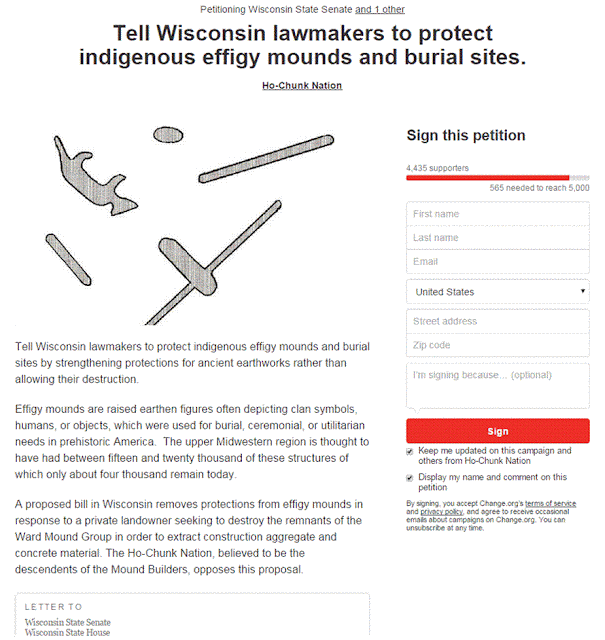
Ho-Chunk Nation Change.org Petition to Protect Indigenous Effigy Mounds and Burial Sites


"The Ho-Chunk people believe that the disturbance of these sites, for whatever reason, constitutes desecration. Under the proposed legislation, a burial site or effigy mound would be ravaged just to definitively prove that remains were present and if no remains were found, the effigy could be totally demolished. These structures must be preserved with respect and dignity."


"Introduced by Representatives R. Brooks, Gannon, Allen, Born, Czaja, Knodl, Swearingen, Vorpagel and Sanfelippa, cosponsored by Senators Kapenga and Strebel. 
Referred to Committee on Environment and Forestry."

For more information,
Visit:
  • Save the Mounds
    • Rally January 12, 2016.
  • Proposed 2015 Assembly Bill 620
    • Wisconsin State Legislature
  • Bill would lift protections on some historic effigy mounds
    • Jason Stein, Milwaukee Wisconsin Journal Sentinel, January 2, 2016.
    • "Under the draft measure, the Wisconsin Historical Society would be required to give property owners a permit allowing them to investigate at their own expense whether their mounds contain burial remains, either through an archaeological dig or through ground-penetrating radar. If the mounds contained no remains, landowners could use their property however they wished."
  • Tribes to Rally Tuesday Against Moving Graves
    • WXPR 91.7 FM, January 7, 2016.
  • Desecration of Graves Sanctioned by Wisconsin Assembly Bill
    • Pam Hues, Indian Country Today, January 6, 2016.
    • "In the case of the Effigy Monument National Park investigation, the report describes management self-proclaiming Section 106 and other regulation compliance exemptions based on previous “disturbances” in the park by farming or infrastructure construction. Officials claimed that disturbances negated the need for consultation on the sites. Similarly, the Wisconsin law as proposed would allow disturbance of burial mounds to prove the existence of human remains, and that type of disturbance could eliminate the mound from completely protected status if mitigation or minimization were deemed appropriate based on the degree of disturbance."
  • Follow the Money on the Indian Burial Mounds Bill
    • Wisconsin Democracy Campaign, January 6, 2016.
Link provided requires a sign in to ProQuest
Ohio State University students can use their student log-in to access the database