Showing posts with label Basketweaving. Show all posts

Thursday, September 29, 2022

Our Storytellers Bodéwadmi Wisgat Gokpenagen The Black Ash Baskets of the Pokagon Band of Potawatomi Indians Exhibit Opening

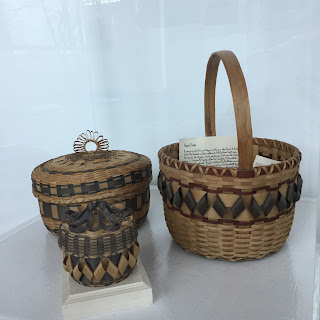
Three baskets made of splints from the Black Ash tree. Some strips are colored a deep brown and a soft black. Image courtesy of the Newark Earthworks Center, The Ohio State University.
October 10, 2022

4 PM

Free and Open to the Public.

Celebrate Indigenous Peoples' Day with us!!!

Bricker Hall Lobby

190 North Oval Mall | Columbus, OH 43210

Potawatomi basket making is a reclamation and recovery of a powerful piece of native knowledge and technology and represents a potent counter-colonial and counter-hegemonic act with lasting implications. This exhibit reflects an understanding that objects are not lifeless things that occupy space. They have spirit and meaning. Centered upon intellectual and material property, basket weaving is an opportunity for Native women and men to make their own histories by using the past to "read the present.

This exhibit is curated by Director of the Newark Earthworks Center John N. Low, PhD, associate professor in Comparative Studies at The Ohio State University and enrolled citizen of the Pokagon Band of Potawatomi.

Sponsored by The Newark Earthworks Center with support from an Indigenous Arts and Humanities Grant by the Global Arts + Humanities Discovery Theme.

For more information,
Visit:

Thursday, May 20, 2021

OSU-Newark's Dr. Low curates Chicago museum basket-making exhibit

May 16, 2021.
Kent Mallett, of the Newark Advocate, has written a brief article introducing the Field Museum's new temporary exhibit Pokagon Potawatomi Black Ash Baskets.

"The revered practice of basket weaving has been threatened during the last century by government policies and the emerald ash borer’s destruction of black ash trees used in basket making. This exhibit tells the story of Pokagon Potawatomi resilience and warns of calamitous impending environmental consequences."

To read the full articleclick here.

For more information,
Visit:

Thursday, April 15, 2021

Pokagon Potawatomi Black Ash Baskets: Our Storytellers

A mix of contemporary decorative baskets sitting inside a large, berry-picking basket. A small tied bundle of tobacco-a sacred medicine that cleanses, comforts, and offers protection-accompanies the baskets. Image courtesy of Dr. John N. Low.
A mix of contemporary decorative baskets sitting inside a large, berry-picking basket.
 A small tied bundle of tobacco-a sacred medicine that cleanses, comforts,
 and offers protection-accompanies the baskets.
Image courtesy of Dr. John N. Low.

Pokagon Potawatomi Black Ash Baskets: Our Storytellers opens to the public April 16, 2021 in the Maran Gallery near the Maori House.


In the last century, items of Native material culture have become items for non-Native collections, museums, and exhibitions-although they were often poorly labeled, identified, and understood. However, particularly since the 1990s, Native peoples have demanded a voice and authority in sharing the beauty, technology, and meaning of their art and artifacts. One of the powers in these objects includes the ability to facilitate conversations between peoples of different communities and backgrounds. The Field Museum has been an important example of the new way in which Natives and non-Natives collaborate on exhibitions about Indigenous cultures. This spring the Field Museum will open Pokagon Potawatomi Black Ash Baskets: Our Storytellers to further strengthen the transition to shared storytelling.

Many of the baskets in the exhibition will share their stories with visitors. This basket, crafted in the 1960s, shares that it was sold in order to help its maker earn a living. Image courtesy of Dr. John N. Low.
Many of the baskets in the exhibition
will share their stories with visitors.
This basket, crafted in the 1960s,
shares that it was sold in order to help its maker earn a living.
Image courtesy of Dr. John N. Low.

The Pokagon Potawatomi peoples are familiar with the traditions of our ancestors and know the multiplicity of stories within baskets. The baskets-assumed silent, static, and lifeless-speak to many of us. We have ears that will listen. We know the origins. The baskets are imbued with the spirit of the material and maker. We hear the stories that the basket waits to tell. A thank you prayer, spoken softly, a song sung to the basket as busy hands work the ash. Hands that lay down tobacco, weave strips into another life; scrape ribbons of wood until they are as smooth as satin. Listen for the voices that sing children to sleep, comfort a partner, worry over an elder, and pray. The hands heard weaving are the same hands that make bread and plant seeds for food. Seeds of knowledge and wisdom are also planted with these busy hands. Stories emanate from the baskets. Like the songs, prayers, and plantings of our grandmothers, we hear those stories. Because we know to listen. We know the songs the baskets sing.

This exhibition celebrates these baskets and their makers. It tells a story of survival and resilience. But it also contains a cautionary tale and a warning of environmental catastrophe as the emerald ash borer, an invasive beetle from Asia, decimates black ash populations in North America. What will the Pokagon Potawatomi make their iconic baskets out of if all the black ash trees are gone? That is a question that concerns us all.

 -Dr. John N. Low, Pokagon Band of Potawatomi Co-Curator and Basket Caretaker.

Thursday, April 23, 2020

USDA Natural Resources Conservation Service Culturally Significant Plants


November 27, 2019.
The U.S. Forest Service, has written an informative post about their initiative with the Eastern Band of Cherokee Indians "to conserve and restore important plant species through research, education and active ecosystem management. " It is intended to restore, manage, and build research around culturally significant plants and ecological management.

"The charter reinforces that the Cherokee relationship with plants and the land supports both current and past connections to language, cultural practices, education and identity."

To read the full postclick here.

For more information,
visit:

Friday, April 3, 2020

Best Wishes


Black ash baskets exhibited in Bodéwadmi Wisgat Gokpenagen |  The Black Ash Baskets of the Pokagon Band of Potawatomi Indians in Sullivant Hall 141. Image Courtesy of the Newark Earthworks Center.
Black ash baskets exhibited in Bodéwadmi Wisgat Gokpenagen |
The Black Ash Baskets of the Pokagon Band of Potawatomi Indians in Sullivant Hall 141.
Image Courtesy of the Newark Earthworks Center.

While we research from home, you can still contact us
through our phone and email. 

740-364-9574 and earthworks@osu.edu

We wish the very best for our students and community
in these challenging times.

Thursday, February 13, 2020

February 14, 2020: Bodéwadmi Wisgat Gokpenagen | The Black Ash Baskets of the Pokagon Band of Potawatomi Indians Opening


Art and Artifact Material Culture and Meaning Making Exhibit Opening Flyer. Image courtesy of NativeOSU.
......................................................................................................................................................................................................................................................................................

Director of the Newark Earthworks Center John Low (Pokagon Band of Potawatomi) and Director of the American Indian Studies Program Daniel Rivers (Choctaw) will speak. 

February 14, 2020
3 - 6 PM

Food and drink will be served; come help us celebrate AIS at OSU!

Free and open to the public.

Sullivant Hall Collaboratory 141
1813 N High Street
Columbus, OH 43210

......................................................................................................................................................................................................................................................................................

According to exhibit curator John N. Low, PhD, Potawatomi basket making is a reclamation and recovery of a piece of native knowledge and technology, and it represents a potent counter-colonial and counter-hegemonic act with lasting implications. Low is an Associate Professor of Comparative Studies at Ohio State Newark and an enrolled citizen of the Pokagon Band of Potawatomi Indians.

“This exhibit reflects an understanding that objects are not lifeless things that occupy space. They have spirit and meaning,” he said. “Centered upon intellectual and material property, basket weaving is an opportunity for native women and men to make their own histories by using the past to ‘read’ the present.”

The exhibit is sponsored by grants from The Ohio State University Global Arts and Humanities’ Indigenous Arts and Humanities InitiativeAmerican Indian Studies program, Ohio State Newark Milliken Fund and the Newark Earthworks Center

“This is an opportunity to learn about and enjoy the artistry of American Indian peoples of the Midwest. The exhibit explores the ways in which objects like baskets communicate to those who take the time to ‘listen’,” said Low. “See the iconic black ash basketry of the Potawatomi Indians, and join in the celebration of the revival of this art.”

This exhibit was previously shown at the LeFevre Art Gallery on the Ohio State University Newark campus.

Director of the Newark Earthworks Center John Low received his PhD in American Culture from the University of Michigan. His most recent book, Imprints: The Pokagon Band of Potawatomi Indians & the City of Chicago, was published by the Michigan State University Press (2016).

For more information, visit: https://www.instagram.com/p/B8eV69DF545/ .

Wednesday, December 11, 2019

Don't Miss Our Bodéwadmi Wisgat Gokpenagen The Black Ash Baskets of the Pokagon Band of Potawatomi Indians Exhibit!

Art & Artifact: Material Culture & Meaning Making Exhibit Flyer. PDF available.
PDF available.
Our exhibit closes December 15th, 2019!

LeFevre Art Gallery, LeFevre Hall
The Ohio State University at Newark
Newark, OH 43055

Join us for the opening of a visual journey
 through the history of the Potawatomi people and their art of black ash basket making!


Potawatomi basket making is a reclamation and recovery of a powerful piece of native knowledge and technology and represents a potent counter-colonial and counter-hegemonic act with lasting implications. This exhibit reflects an understanding that objects are not lifeless things that occupy space. They have spirit and meaning. Centered upon intellectual and material property, basket weaving is an opportunity for Native women and men to make their own histories by using the past to ‘read’ the present.
The exhibit is curated by John N. Low, PhD, associate professor in Comparative Studies at the Ohio State University and enrolled citizen of the Pokagon Band of Potawatomi Indians. He received his PhD in American Culture from the University of Michigan. His most recent book Imprints: The Pokagon Band of Potawatomi Indians & the City of Chicago was published by the Michigan State University Press (2016).
Sponsored by grants from the Global Arts & Humanities/ Indigenous Arts & Humanities Initiative, American Indian Studies, the Milliken Fund at The Ohio State University at Newark,
 and the Newark Earthworks Center.

Wednesday, October 9, 2019

Celebrate Indigenous Peoples' Day at Ohio State Newark!

October 14, 2019
Description:
Indigenous Peoples' Day Flyer. PDF available.
PDF available.

7 - 8 PM

Join us as we celebrate Indigenous People’s Day with Pokagon Potawatomi basket maker Jennie Brown and family!

John L. and Christine Warner 
Library and Student Center
Performance Platform (Room 126)

Free and open to the public. 

The Brown family includes several generations of black ash basket makers. Jennie, mother of Jamie, won the Daniel “Gomez” Mena Master Apprenticeship for her work as a mentor to her son and apprentice Josiah. Jamie’s large strawberry basket was featured on the cover of an issue of the National Museum of the American Indian magazine; and the Smithsonian Institute purchased and will soon display that piece. They will discuss the meaning and power of basket making
This presentation is in conjunction with the exhibit currently being featured in the LeFevre Hall Art Gallery entitled “Art & Artifact: Material Culture & Meaning Making - Bodéwadmi Wisgat Gokpenagen, The Black Ash Baskets of the Pokagon Band of Potawatomi Indians.” 

Sponsored by grants from the Global Arts & Humanities/ Indigenous Arts & Humanities Initiative, the Program in American Indian Studies, the Milliken Fund at The Ohio State University at Newark, and the Newark Earthworks Center.

For more information,
Visit:

Thursday, September 12, 2019

Gallery Opening of Bodéwadmi Wisgat Gokpenagen, The Black Ash Baskets of the Pokagon Band of Potawatomi Indians

Exhibit Opening Friday, September 13, 4 PM, LeFevre Gallery in LeFevre Hall. Art & Artifact: Material Culture & Meaning Making. Bodéwadmi Wisgat Gokpenagen, The Black Ash Baskets of the Pokagon Band of Potawatomi Indians. Image Courtesy of LeFevre Art Gallery, The Ohio State University at Newark.

September 13 - December 15, 2019.


Exhibit Opening Friday, September 13, 2019
4 PM

LeFevre Art Gallery, LeFevre Hall
The Ohio State University at Newark
Newark, OH 43055

Join us for the opening of a visual journey
through the history of the Potawatomi people and their art of black ash basket making!

This event is free and open to the public.

Potawatomi basket making is a reclamation and recovery of a powerful piece of native knowledge and technology and represents a potent counter-colonial and counter-hegemonic act with lasting implications. This exhibit reflects an understanding that objects are not lifeless things that occupy space. They have spirit and meaning. Centered upon intellectual and material property, basket weaving is an opportunity for Native women and men to make their own histories by using the past to ‘read’ the present.

According to exhibit curator John N. Low, PhD, Potawatomi basket making is a reclamation and recovery of a piece of native knowledge and technology, and it represents a potent counter-colonial and counter-hegemonic act with lasting implications. Low is Director of the Newark Earthworks Center, an associate professor of Comparative Studies at Ohio State Newark, and an enrolled citizen of the Pokagon Band of Potawatomi Indians.

“This exhibit reflects an understanding that objects are not lifeless things that occupy space. They have spirit and meaning,” he said. “Centered upon intellectual and material property, basket weaving is an opportunity for native women and men to make their own histories by using the past to ‘read’ the present.”

“This is an opportunity to learn about and enjoy the artistry of American Indian peoples of the Midwest. The exhibit explores the ways in which objects like baskets communicate to those who take the time to ‘listen’,” said Low. “See the iconic black ash basketry of the Potawatomi Indians, and join in the celebration of the revival of this art.”


For more information,
Visit:

Thursday, July 21, 2016

Did Women and Children Exist in Prehistory?

"The archaeological record tends to preserve stone tools rather than perishable remains,  such as this split-twig figurine found in Dolores Cave, near Gunnison, Colorado." Image Courtesy of Sapiens and the Denver Museum of Nature & Science (A1291.1).
"The archaeological record tends to preserve stone tools rather than perishable remains,
such as this split-twig figurine found in Dolores Cave, near Gunnison, Colorado."
Image Courtesy of Sapiens and the Denver Museum of Nature & Science (A1291.1). 
June 15, 2016.
Stephen E. Nash, of SAPIENS, has written a thoughtful article about the importance of including women and children in archaeological interpretations of the past.

"I have long been troubled by archaeological research on Paleoindian North America, where Clovis, Folsom, and other projectile-point styles, dating from about 13,000 to 9,000 years ago, are analyzed as if no other technologies existed. Part of this emphasis on projectile points is a function of preservation—whereas kill sites, hunting camps, bones, and stone tools are reasonably well-preserved across the American West, Paleoindian campsites are rare, and perishable remains (e.g., nets, baskets, clothing, shoes, etc.) are even rarer..."

To read the full articleclick here.

For more information,
Visit:

Tuesday, July 12, 2016

The Language of Native American Baskets from the weavers' view

http://nmai.si.edu/exhibitions/baskets/index.cfm

Introduction
"In earlier days, baskets accompanied Indian people throughout their lives. Babies were carried in baskets, meals were prepared and cooked in them, worldly goods were stored in them, and people were buried in them. As the scene described here by writer Peter Blue Cloud makes clear, many Native American people believe that baskets were not given to humankind during the Creation, but had already been part of the world for many eternities. Today, baskets serve as markers of cultural pride and inheritance. Some are used on religious occasions. And hundreds of weavers make baskets for sale.

I began this exhibition with the idea that we can understand baskets through the details of their making—the weavers’ view. This idea is based upon a knowledge of baskets gained through many years of conversations with weavers, observation, and hands-on learning. Understanding basketmaking as process offers a means to see the interrelation of conception, creation, and expression.

Objects for the exhibition were then preliminarily selected and laid-out and five Native basket-makers and one Native basketry scholar were invited to a two-day seminar to review the proposed contents and organization. While the basic outline of the exhibition remained constant, the consulting curators honed my ideas and choices. Above all, they wished to see more contemporary baskets on view. They wanted to make clear that basketry is a living art, and that the baskets in the Museum’s collections remain rooted in their cultures, no matter how long ago they were made, used, purchased, and removed from their communities.... "
-Bruce Bernstein, Assistant Director for Cultural Resources, 
National Museum of the American Indian.

The Weavers' View
Each weavers' view includes a selection of 7-8 images of contemporary and historic baskets.

  • Lisa Telford, Haida
  • Pat Courtney Gold, Wasco Nation of the Warm Springs Confederacy
  • Julia Parker, Pomo & Sherrie Smith-Ferri, Dry Creek Pomo and Bodega Bay Miwok
  • Terrol Johnson, Tohono O'odham
  • Theresa Hoffman, Penobscot

Techniques, Tools & Workplaces

  • Techniques
    • 45 baskets
    • Plaiting
    • Wicker
    • Twining
    • Coiling
  • Tools & Workplaces

The Weavers' Aesthetic

  • Materials
    • 20 baskets
  • Starts & Finishes
    • 20 baskets
  • Splices & Workfaces
    • 10 baskets
  • Shape
    • 12 baskets
  • Design Field
    • 16 baskets
    • “I always point out that at one time the designs were new, people had to absorb them. But because we have been doing them for so long, now they’re considered traditional.”-Terrol Johnson, Tohono O’odham

Burden Baskets

  • 30 baskets
  • Open burden baskets
  • Closed burden baskets
  • Hats and small burden baskets

A Set of Values

  • 25 baskets
  • "Too often, when people think about Native American baskets, they assume that the weavers who make them are hemmed in by rules that govern the “traditional” arts. Nothing could be further from the truth. Tradition is not a list of rules, but rather a set of values that guide the weaver’s work."

Basketmaking Associations

Tuesday, July 5, 2016

Midwest American Indian & Earthworks Video

"Tribal Participation in the Preservation of the Newark Earthworks" 
-Interim Director Marti Chaatsmith February 18, 2015

When researching a new topic or trying to find more information, finding videos with reliable sources is difficult. Midwest American Indian & Earthworks Videos is our attempt at collating 
free, online, informational videos about American Indian cultures, particularly from the Great Lakes, and monumental earthworks histories worldwide. These videos represent a small sample of current or recent knowledge and we hope you find them useful to introduce topics and terms for research, general knowledge, and to use as classroom resources. This is by no means a comprehensive list and links may be subject to change. As time passes, information is updated and 
so described conclusions may no longer be valid.

The full Midwest American Indian & Earthworks Videos tab is
always available on the right-hand side of our blog,
under the heading Collected Resources.


We welcome your input and would like to hear from you; 
please contact us at earthworks@osu.edu .

The views, opinions, and beliefs expressed within all articles, videos, and links from this blog
do not necessarily represent The Ohio State University or the Newark Earthworks Center.

Tuesday, June 7, 2016

Across Borders | Beadwork in Iroquois Life

Across Borders: Beadwork in Iroquois Life

"The story of the Iroquois beadwork takes us across many borders, both real and conceptual. We will travel from European glass factories to the Iroquois territories of North America. We will see how beadwork, though always a feature of everyday life, is also linked to the spiritual, economic and political worlds of the Iroquois. The story of beadwork moves smoothly between past and present. It is a story marked by continuity, innovation, determination, humor and, ultimately, survival."

an introduction
five objects
  1. Mohawk hanging basket
  2. Seneca picture frame
  3. Tuscarora bag
  4. Mohawk pincushion
  5. Mohawk pincushion 2

exhibit-related programs
giveaways
Iroquois Creation Story
acknowledgements

Made of Thunder, Made of Glass II: Continuing Traditions in Northeastern Indian Beadwork

Interested in visiting a similar exhibit in person?

The Castellani Art Museum of Niagara University is hosting the exhibition
through June 26, 2016.

For More Information,
Visit:

Tuesday, May 17, 2016

National Museum of the American Indian Educational Resources (2)

National Museum of the American Indian Educational Resources

Collections

Index of Resources

Did You Know?

  • Do all Indians live in tipis?
  • What is the correct terminology: American Indian, Indian, Native American, or Native?
  • How many Indians lived in America before 1492?
  • Before Contact with Europeans, did Indians make all their clothes from animal skins?
  • Do Indians do rain dances?
  • Do Indians have to pay taxes?

Educator E-Newsletter

"Learn about the NMAI's educational resources—including curriculum for the classroom, teacher workshops, and educational strategies—in the museum’s free, quarterly teacher e-newsletter."
Available online as PDFs.
  • Spring 2015
  • Winter 2015
  • Fall 2014
  • September 2014
  • Spring 2014
  • March 2014
  • Winter 2014

Educator Programs

"Professional development opportunities for teachers at the National Museum of the American Indian can benefit educators in all subject areas. Workshops span a range of topics and enable teachers to discover analytical approaches to connect the museum's collections and content with classroom teaching strategies. Sessions help educators explore new content about American Indian cultures and history and encourage new methods for teaching with objects in the classroom. Workshops include take-home materials and classroom resources, as well as new ideas for interdisciplinary curriculum connections."

Classroom Lessons

Nations or Regions

  • Manhatta to Manhattan: Native Americans in Lower Manhattan (PDF available)
    • "In this booklet you will learn about the Native people of Lower Manhattan and the lasting impressions they left on this area"
  • The Haudenosaunee Guide for Educators (PDF available)
    • " It was our hope to provide educators with a deeper and more integrated understanding of Haudenosaunee life, past and present. This guide is intended to be used as a supplement to your mandated curriculum. "
  • We Have a Story to Tell: Native Peoples of the Chesapeake (PDF available)
    • " intended for use with students in grades 9-12. Ways of life before contact with Europeans are briefly introduced. This is followed by coverage of the period of colonization (1607) through the present. The guide focuses especially on how Powhatan, Nanticoke, and Piscataway peoples responded to the upheavals that began with the colonial period. It includes activities that fix attention on critical contemporary issues that affect Native communities in the region"
      • Introduction for Teachers
      • Reading
        • Native Peoples of the Chesapeake Region and the Enduring Effects of Colonialism
      • Small Group Project and Class Presentation
        • Issues of Survival for Native Communities of the Chesapeake Region
      • Maps, Resources, Works Cited
  • Lone Dog's Winter Count: Keeping History Alive (PDF available)
    • Grade Level 4-8.
    • "Students learn about the oral culture and history-keeping of the Nakota people, who made the Lone Dog Winter Count. Then they create a monthly pictograph calendar of their own to document a year of their personal history"

Themes

Expressive Traditions

  • Smithsonian in Your Classroom: Native Dolls (PDF available)
    • "In our lesson plan we present the perspectives and experiences of Native doll makers describing how their work is keeping old traditions and developing new ones. These Native voices encourage students to examine dolls from the collections of the museum and to connect them to the diverse cultures, communities, and environments they represent. "
      • Background
      • Lesson Plan
      • Navajo Dolls
      • Inupiat Dolls
      • Ojibwe Doll
      • Seneca Dolls
      • Seminole Doll
      • Map
  • Identity by Design (Exhibit website)
    • tradition, change, and celebration in native women's dresses
      • Introduction
      • 19th-Century Style
      • Full Circle of Life
      • Indigenous Innovation
      • Forming Cultural Identity
      • Dancing in Beauty
      • The Powwow World
      • Resources
  • Fritz Scholder Study Guide (Grades 5-8) (PDF available)
    • "This lesson explains abstract expressionism through an examination of a Scholder landscape painting titled New Mexico No. 1. Students will also learn how art can make a statement about identity by exploring Scholder’s life and examining other works, including Heart Indian. Students will create a self-portrait based on the style of Scholder."
  • Fritz Holder: Indian/Not Indian (Exhibit website)
    • Introduction
    • Biography
    • Works
    • Press
    • Resources
    • Programs
    • Podcasts
  • Fritz Scholder Guide for Young People (7 & Up) (PDF available)
    • "This guide provides parents and children with background information, questions, and suggestions to help focus on a few of the pieces in this exhibit. First, read the biographical information on the back. Then, open the guide and: find the artwork pictured. read the background information in this guide. look at the piece as a whole, and then the colors, texture, and other small details. talk about what you see and how it makes you think and feel. compare the piece to others in the exhibit."
  • Looking at Fritz Scholder (PDF available)
    • "This activity guide is designed for you and your family to use together as you explore the works of Fritz Scholder on display in this exhibition. "

Thanksgiving

  • American Indian Perspectives on Thanksgiving (PDF available)
    •  a resource for teachers to use as a jumping-off point for more in-depth discussion. Discussion and other classroom ideas are included in each section."
  • Harvest Ceremony: Beyond the Thanksgiving Myth (PDF available)
    • "Contemporary celebrations of the Thanksgiving holiday focus on the idea that the “first Thanksgiving” was a friendly gathering of two disparate groups—or even neighbors—who shared a meal and lived harmoniously. In actuality, the assembly of these people had much more to do with political alliances, diplomacy, and an effort at rarely achieved, temporary peaceful coexistence. Although Native American people have always given thanks for the world around them, the Thanksgiving celebrated today is more a combination of Puritan religious practices and the European festival called Harvest Home, which then grew to encompass Native foods."
      • The First People
      • The Immigrants
      • Contact
      • The Harvest Celebration
      • The Wampanoag Today
      • Afterword
      • Classroom Discussion Topics

History

  • Native Words | Native Warriors (Exhibit website)
    •  Introduction
    • Native Languages
    • Code Talking
    • Survival
    • Boarding Schools
    • Coming Home
    • Recognition
    • Lesson Plan
    • Resources
* Links provided are not all that are available on the National Museum of the American Indian
This post is intended to inform; not reproduce the NMAI's website.

Tuesday, December 22, 2015

Bringing It Home: Artists Reconnecting Cultural Heritage with Community, NMAI

In case you missed it, on December 6th, 2015 the National Museum of the American Indian gave a live webcast of the most recent findings from their Artist Leadership Program (APL);
which is now fully available on their Youtube Channel

"Moderator: Dr. Gabrielle Tayac (Piscataway Indian Nation), NMAI Historian

Panelists: Maura Garcia (Cherokee/Mattamuskeet), Porfirio Gutiérrez (Zapotec),
Linley Logan (Onondowaga), Theresa Secord (Penobscot Nation)

Participants in the museum’s Artist Leadership Program will discuss their work, their research with the Smithsonian, and their plan to share their experiences and knowledge with their community.

Maura Garcia, from Kansas, whose artistic medium is dance and multimedia performance. Garcia plans to incorporate elements from the museum's collections and work with the youth of the Kansas City Indian Center to create an urban Indigenous public performance. Her primary research focuses on the Cahokia and Spiro sites and the central Mississippi Valley mound sites within 500 miles of present-day Kansas City.

Porfirio Gutiérrez, who lives in California and is a master Zapotec weaver who works with natural dyes. Gutierrez plans to research Zapotec textile art fabrication techniques and to verify that methods used in the past are still in use today.  He will do his community project in Teotitlan del Valle, near Oaxaca, Mexico, a town known for its traditional Zapotec weavings, made with fibers dyed with local plants and insects.

Linley Logan, who lives in Washington state and works with Seneca beadwork designs. Logan will do his community project in Tonawonde Onondowaga Yoindzade, his traditional Longhouse community in New York State. His primary research focuses on Seneca/Iroquois beadwork clothing patterns, as well as clothing materials such as porcupine quillwork.

Theresa Secord lives in Maine, is nationally known as an ash and sweetgrass basket maker. Secord will share her knowledge and experience from the NMAI with the Penobscot Nation and other Wabanaki basket makers at the Hudson Museum at the University of Maine and in the Penobscot tribal community on Indian Island, Maine. As ash trees become extinct due to bug infestation, she is researching Wabanaki basketry to learn more about other non-traditional materials in weaving practices, such as basswood fiber and cedar."
For more information,
Visit: