Showing posts with label Earthworks News. Show all posts

Thursday, October 3, 2024

Octagon Open Houses | October 20 and 21st, 2024


The Octagon State Memorial, Newark Earthworks Map. Image courtesy of the Ancient Ohio Trail.
The Octagon State Memorial, Newark Earthworks Map.
Image courtesy of the Ancient Ohio Trail.

The Octagon State Memorial is one of the most spectacular surviving remnants of the Newark Earthworks and is part of the Hopewell Ceremonial Earthworks.

The Octagon is connected to a perfectly circular enclosure 1,054 feet in diameter. The architecture of the Octagon Earthworks encodes a sophisticated understanding of geometry and astronomy. It is a National Historical Landmark and part of the Hopewell Ceremonial Earthworks UNESCO World Heritage site.

Simulated moonrise over the Newark Earthworks' observatory mound as it would have been 200 B.C. - 400 A.D. Image Courtesy of the Ancient Ohio Trail and CERHAS of the University of Cincinnati.

The precise geometry of Newark’s circle-octagon centers on its axial center line, beginning at the center of the Observatory Mound and pointing 38 degrees north of east. It’s a long line of sight which, if the site were cleared of trees, would lead the eye to a precise point on distant horizon. From here, as a result of generations of careful measurements and designing, the American Indians 2,000 years ago could predict, and bear witness to, the return of the moon to its northernmost position – just once every 6,789 days.

The movements of the moon are complex. Nowadays, we notice that the moon has different phases over about 29 days. But the builders of the earthworks noticed much more complicated lunar patterns: first, about every four weeks its rising point swings back and forth between the southeast and the northeast; and second, the width of this angle expands very slowly over about 9 1/3 years (about 3395 days), and then contracts again at the same rate. The moon’s setting points move the same way across the western horizon.

So there are eight points where the moon appears to reverse direction along the horizon during this long, complex cycle. Remarkably, all eight are marked precisely by these earthen walls and gateways. The architecture here tells us which one mattered the most: the extreme northernmost moonrise perfectly aligns along the central axis of the Octagon. This happened only once in 18.6 years or 6,789 days.

Portions of the Octagon Earthworks is open to the public during daylight hours 365 days a year, but much of the site is used as a private golf course for most of the year, so access is restricted. Five times this year, however, golfing is suspended and the entire site is made available to the general public.

The grounds of the Octagon State Memorial [external link] will be open to the public for general strolling and viewing from sunrise to sunset.

Octagon State Memorial, 125 N. 33rd Street, Newark, OH 43055

Take your tour with you, with The Ancient Ohio Trail [external link].

We hope to see you there!

These are the last public open houses of 2024.

For more information, visit Ohio History Connection [external link].


Monday, July 1, 2024

Octagon Open House | July 22, 2024

The Octagon State Memorial, Newark Earthworks Map. Image courtesy of the Ancient Ohio Trail.
The Octagon State Memorial, Newark Earthworks Map.
Image courtesy of the Ancient Ohio Trail.

The Octagon State Memorial is one of the most spectacular surviving remnants of the Newark Earthworks and is part of the Hopewell Ceremonial Earthworks.

The Octagon is connected to a perfectly circular enclosure 1,054 feet in diameter. The architecture of the Octagon Earthworks encodes a sophisticated understanding of geometry and astronomy. It is a National Historical Landmark and part of the Hopewell Ceremonial Earthworks UNESCO World Heritage site.

Simulated moonrise over the Newark Earthworks' observatory mound as it would have been 200 B.C. - 400 A.D. Image Courtesy of the Ancient Ohio Trail and CERHAS of the University of Cincinnati.

The precise geometry of Newark’s circle-octagon centers on its axial center line, beginning at the center of the Observatory Mound and pointing 38 degrees north of east. It’s a long line of sight which, if the site were cleared of trees, would lead the eye to a precise point on distant horizon. From here, as a result of generations of careful measurements and designing, the American Indians 2,000 years ago could predict, and bear witness to, the return of the moon to its northernmost position – just once every 6,789 days.

The movements of the moon are complex. Nowadays, we notice that the moon has different phases over about 29 days. But the builders of the earthworks noticed much more complicated lunar patterns: first, about every four weeks its rising point swings back and forth between the southeast and the northeast; and second, the width of this angle expands very slowly over about 9 1/3 years (about 3395 days), and then contracts again at the same rate. The moon’s setting points move the same way across the western horizon.

So there are eight points where the moon appears to reverse direction along the horizon during this long, complex cycle. Remarkably, all eight are marked precisely by these earthen walls and gateways. The architecture here tells us which one mattered the most: the extreme northernmost moonrise perfectly aligns along the central axis of the Octagon. This happened only once in 18.6 years or 6,789 days.

Portions of the Octagon Earthworks is open to the public during daylight hours 365 days a year, but much of the site is used as a private golf course for most of the year, so access is restricted. Five times this year, however, golfing is suspended and the entire site is made available to the general public.

The grounds of the Octagon State Memorial [external link] will be open to the public for general strolling and viewing from sunrise to sunset.

Octagon State Memorial, 125 N. 33rd Street, Newark, OH 43055

Take your tour with you, with The Ancient Ohio Trail [external link].

We hope to see you there!

Can't make it this time? The other Open Houses this year are: 

  • Sunday, October 20th
  • Monday, October 21st

For more information, visit Ohio History Connection [external link].

Monday, April 15, 2024

Mounds and Memory Gathering 2024: Indigenous Sovereignty, Ceremonial Spaces, and Stories of the Mound Builders

​May 15, 2024

Cartoon Room 1, Ohio Union, Columbus Campus
9 a.m. - 7 p.m.

The moon above the Newark Earthworks' Octagon State Memorial with a lightening sky. Image courtesy of Timothy E. Black.

The Newark Earthworks are the largest set of geometric earthen enclosures in the world. Honored as a UNESCO World Heritage Site in 2023, the entire Newark Earthworks originally encompassed more than four square miles. It was built between CE 1 to CE 400 by the ancestors of contemporary American Indian peoples who are identified today as the Hopewell Culture/Era. This architectural wonder was part cathedral, part university, part social space, part cemetery and part astronomical observatory. Through their genius, hard work, and collaborative efforts these ancestors inscribed upon the land a remarkable wealth of indigenous knowledge relating to geometry and astronomy encoded in the design of these earthworks. The Octagon Earthworks are aligned to the four moonrises and four moonsets that mark the limits of a complicated 18 year and 219 day-long cycle north and south on the eastern horizon.

This Gathering is built upon the hard work of organizers and attendees of previous Mounds & Memory workshops and the goal of this Gathering is to reunite participants in previous workshops, including representatives of the Rainy River First Nations (Ontario), the Pokagon Band of Potawatomi Nation, The Ohio State University, the University of Toronto, and Harvard University. to share and celebrate these "monuments of the Ohio River Valley." 

Our Lecture Agenda will be posted on this page shortly.

Speakers:

  • Jennifer Aultman, Chief Historic Sites Officer, Ohio History Connection
  • Kevin Daugherty (Pokagon Band of Potawatomi) Language Specialist and Elder
  • Steven Gavazzi, Director of CHHR, The Ohio State University
  • Bradley Lepper, Curator of Archaeology, Ohio History Connection
  • Lucy Murphy, Professor Emeritus of History, The Ohio State University
  • Kevin Nolan, Director and Senior Archaeologist of Applied Anthropology Laboratories, Ball State University
  • Justin Parscher, Assistant Professor of Practice Landscape Architecture, Knowlton School of Architecture
  • Richard Shiels, Associate Professor Emeritus of History, The Ohio State University

If you require an accommodation such as interpretation to participate in this event, or other accommodations, please contact Megan Cromwell (cromwell.34@osu.edu) . Requests made by April 30 will help provide seamless access.

Organized by the Newark Earthworks Center-John Low, Steven Gavazzi, Cheryl Cash, Marti Chaatsmith, and Megan Cromwell, with financial support from the Global Arts + Humanities Discovery Themes Program, the Center of Religion, Center for Ethnic Studies, and American Indian Studies and our donors. Thank you.​

Thursday, March 28, 2024

Octagon Open Houses | April 14th and 15th, 2024

The Octagon State Memorial, Newark Earthworks Map. Image courtesy of the Ancient Ohio Trail.
The Octagon State Memorial, Newark Earthworks Map.
Image courtesy of the Ancient Ohio Trail.

The Octagon State Memorial is one of the most spectacular surviving remnants of the Newark Earthworks and is part of the Hopewell Ceremonial Earthworks.

The Octagon is connected to a perfectly circular enclosure 1,054 feet in diameter. The architecture of the Octagon Earthworks encodes a sophisticated understanding of geometry and astronomy. It is a National Historical Landmark and part of the Hopewell Ceremonial Earthworks UNESCO World Heritage site.

Simulated moonrise over the Newark Earthworks' observatory mound as it would have been 200 B.C. - 400 A.D. Image Courtesy of the Ancient Ohio Trail and CERHAS of the University of Cincinnati.

The precise geometry of Newark’s circle-octagon centers on its axial center line, beginning at the center of the Observatory Mound and pointing 38 degrees north of east. It’s a long line of sight which, if the site were cleared of trees, would lead the eye to a precise point on distant horizon. From here, as a result of generations of careful measurements and designing, the American Indians 2,000 years ago could predict, and bear witness to, the return of the moon to its northernmost position – just once every 6,789 days.

The movements of the moon are complex. Nowadays, we notice that the moon has different phases over about 29 days. But the builders of the earthworks noticed much more complicated lunar patterns: first, about every four weeks its rising point swings back and forth between the southeast and the northeast; and second, the width of this angle expands very slowly over about 9 1/3 years (about 3395 days), and then contracts again at the same rate. The moon’s setting points move the same way across the western horizon.

So there are eight points where the moon appears to reverse direction along the horizon during this long, complex cycle. Remarkably, all eight are marked precisely by these earthen walls and gateways. The architecture here tells us which one mattered the most: the extreme northernmost moonrise perfectly aligns along the central axis of the Octagon. This happened only once in 18.6 years or 6,789 days.

Portions of the Octagon Earthworks is open to the public during daylight hours 365 days a year, but much of the site is used as a private golf course for most of the year, so access is restricted. Five times this year, however, golfing is suspended and the entire site is made available to the general public.

The grounds of the Octagon State Memorial [external link] will be open to the public for general strolling and viewing from sunrise to sunset.

Octagon State Memorial, 125 N. 33rd Street, Newark, OH 43055

Take your tour with you, with The Ancient Ohio Trail [external link].

We hope to see you there!

Can't make it this time? The other Open Houses this year are: 

  • Monday, July 22nd
  • Sunday, October 20th
  • Monday, October 21st

For more information, visit Ohio History Connection [external link].

Friday, September 29, 2023

World Heritage Commemoration Open House | October 15, 2023

The Octagon State Memorial, Newark Earthworks Map. Image courtesy of the Ancient Ohio Trail.
The Octagon State Memorial, Newark Earthworks Map.
Image courtesy of the Ancient Ohio Trail.

The Octagon State Memorial is one of the most spectacular surviving remnants of the Newark Earthworks. The Octagon is connected to a perfectly circular enclosure 1,054 feet in diameter. The architecture of the Octagon Earthworks encodes a sophisticated understanding of geometry and astronomy. It is a National Historical Landmark and is on track to become a World Heritage site! Portions of the Octagon Earthworks is open to the public during daylight hours 365 days a year, but much of the site is used as a private golf course for most of the year, so access is restricted. Four times each year, however, golfing is suspended and the entire site is made available to the general public.

The site will be open daylight to dusk.
There is no registration or reservations needed for tours.

The Newark Earthworks served social, ceremonial and astronomical functions for their builders, people of the Hopewell Culture. The site is part of the UNESCO World Heritage Hopewell Ceremonial Earthworks, a National Historic Landmark and Ohio’s official prehistoric monument.

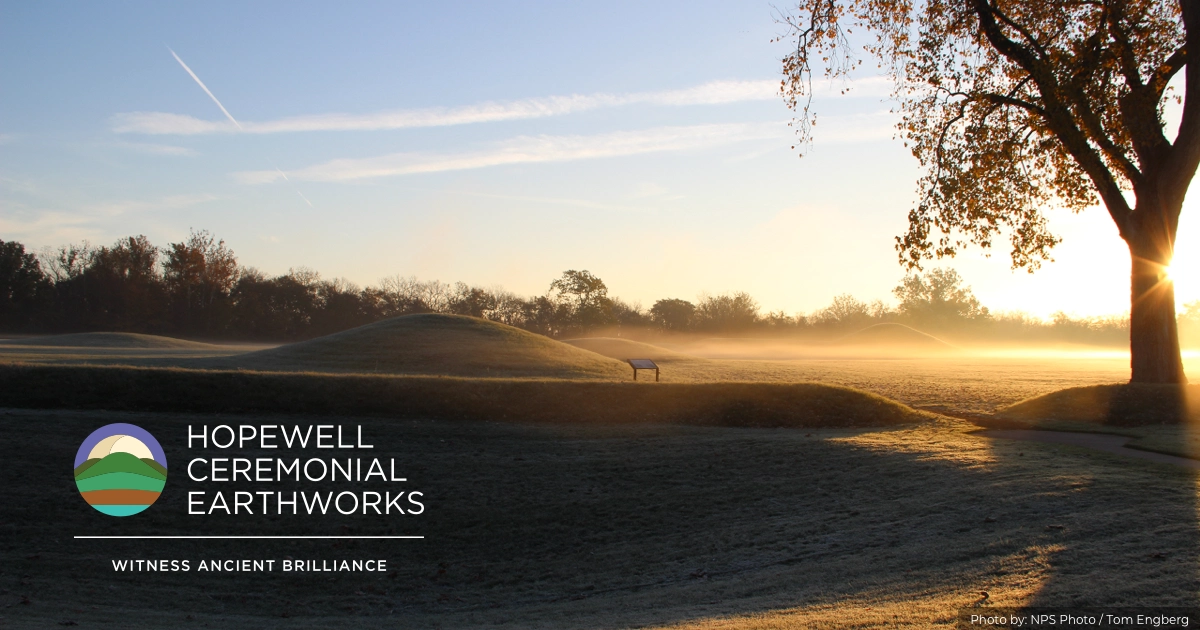
Hopewell Ceremonial Earthworks Witness Ancient Brilliance. View of Mound City earthworks as the sun rises, link to official website. Image courtesy of National Park Service, Tom Engberg.
Hopewell Ceremonial Earthworks | https://hopewellearthworks.org

9:00 a.m. - Noon Remnants Walking Tour

Join one of our expert historians and storytellers, Jeff Gill, for a journey through the Newark earthworks! He will take you on a tour of the remnants of this once four-square mile complex of earthen walls and geometric enclosures that, in the words of Squier and Davis (1848), "can now be traced only at intervals, among gardens and outhouses." Enjoy an autumn walk and learn about the history of how the Newark Earthworks have been preserved for the last 2,000 years!

9:00 a.m. - 9:45 a.m. A Stationary History of the Newark Earthworks

Maybe you don't feel up to a 3-hour walking tour-that's okay! A Newark Earthworks interpreter will pick up where Jeff Gill left off. Join us at the Great Circle Museum to learn about the many stories the Newark Earthworks have to tell and how they have been stewarded by locals of the area for thousands of years!

10:00 a.m. - 1:45 p.m. Filling in the Details: Archaeology of Hopewell Earthworks and Sites in Ohio

Join us as we gather a panel of archaeologists to chat about how we know what we know about the Hopewell Ceremonial Earthworks and the people that created and gathered in these spaces 2,000 years ago, and what we hope to learn in the future.

11:15 a.m. - 12:15 p.m. Newark Earthworks Tours: The Octagon and Great Circle

Join a tour at either one of our sites for an immersive experience of these earthwork complexes! Please note these tours are in different locations and that this is a special day of the year when the Octagon is fully accessible. The Great Circle is open and accessible year-round. You will have the chance to join another tour of the sites at 2 p.m.!

  • Great Circle – 455 Hebron Rd., Heath, OH
  • Octagon Earthworks–125 N. 33rd St., Newark, OH

1:00 p.m. - 1:45 p.m. Commemorating the Journey to World Heritage

The pathway to achieving World Heritage status for eight Hopewell Ceremonial Earthwork sites in Ohio has been years in the making! Join us for a chance to acknowledge the hard work and passion of many people that made this a possibility and what this means for the history and preservation of these sites in the future.

2:00 - 3:00 p.m. Newark Earthworks Tours: The Octagon and the Great Circle

Join a tour at either one of our sites for an immersive experience of these earthwork complexes! Please note these tours are in different locations and that this is a special day of the year when the Octagon is fully accessible. The Great Circle is open and accessible year-round. Dr. John Low is leading a tour at the Octagon State Memorial.
  • Great Circle – 455 Hebron Rd., Heath, OH
  • Octagon Earthworks–125 N. 33rd St., Newark, OH

3:30 - 4:30 p.m. What World Heritage Means and How You Can Play a Role

You might be wondering, "What's the big deal with World Heritage? Why should this matter for us Ohioans and local community members?" Join our panel of experts to learn how achieving World Heritage will be meaningful to us all and how you can be a part of preserving these sacred spaces.

    For more information, visit the Ohio History Connection.

    World Heritage Commemoration Open House Flyer PDF.


    Tuesday, September 19, 2023

    25th United States UNESCO World Heritage Inscription | Hopewell Ceremonial Earthworks

    Hopewell Ceremonial Earthworks, UNESCO World Heritage Site

    World Heritage Celebration at the Great Circle, part of the Newark Earthworks, Heath Ohio. 2013, Tim Black.
    World Heritage Celebration at the Great Circle,
    Part of the Newark Earthworks, Heath Ohio. 2013, Tim Black.
    45th Extended Session of the UNESCO World Heritage Committee | Riyadh, Kingdom of Saudi Arabia

    September 19, 2023

    The United Nations Educational, Scientific and Cultural World Heritage inscription recognizes the identification, protection and preservation of cultural and natural heritage considered of outstanding value for all of humanity.
     
    Nominations by a country must represent at least one of the criteria of world heritage as defined by UNESCO. The authenticity of the nominated site and its protection and management are also considered.


    The Hopewell Ceremonial Earthworks are Ohio's first UNESCO World Heritage inscription and the twenty-fifth for the United States of America.

    Seip Earthworks, large circle North gateway. Hopewell Culture National Park, Chillicothe Ohio. John E. Hancock.
    Seip Earthworks, large circle North gateway.
    Hopewell Culture National Park, Chillicothe Ohio.
    John E. Hancock.

    Aerial view of the Octagon State Memorial, part of the Newark Earthworks, Newark Ohio.
    Aerial view of the Octagon State Memorial,
    Part of the Newark Earthworks, Newark Ohio.
    Hopewell Ceremonial Earthworks is a series of eight monumental earthen enclosure complexes built between 2,000 and 1,600 years ago along the central tributaries of the Ohio River in east-central North America. They are the most representative surviving expressions of the Indigenous tradition now referred to as the Hopewell culture.
    Aerial view of the Hopeton Earthworks, part of the Hopewell Culture National Historical Park, Chillicothe Ohio. First Capital Aerial Media, Tim Anderson Jr.
    Aerial view of the Hopeton Earthworks, Part of the Hopewell
    Culture National Historical Park, Chillicothe Ohio.
    First Capital Aerial Media, Tim Anderson Jr.

    Their scale and complexity are evidenced in precise geometric figures as well as hilltops sculpted to enclose vast, level plazas. Huge earthen squares, circles, and octagons are executed with a precision of form, technique, and dimension consistently deployed across a wide geographic region. 

    There are alignments with the cycles of the Sun and the far more complex cycles of the Moon.
    Aerial view of Mound City, part of the Hopewell Culture National Historical Park, Chillicothe Ohio. National Park Service, John Blank.
    Aerial view of Mound City, Part of the Hopewell Culture
    National Historical Park, Chillicothe Ohio.
    National Park Service, John Blank.

    These earthworks served as ceremonial centers, built by dispersed, non-hierarchical groups whose way of life was supported by a mix of foraging and farming. 

    The sites were the center of a continent-wide sphere of influence and interaction and have yielded finely crafted ritual objects fashioned from exotic raw materials obtained from distant places.

    Criterion (i) Represent a masterpiece of human creative genius

    Hopewell Ceremonial Earthworks comprises highly complex masterpieces of landscape architecture. 

    They are exceptional amongst ancient earthworks worldwide not only in their enormous scale and wide geographic distribution, but also in their geometric precision. 

    These features imply high-precision techniques of design and construction and an observational knowledge of complex astronomical cycles that would have required generations to codify. 


    The series includes the finest extant examples of these various principles, shapes, and alignments, both in geometric earthworks and in the pre-eminent surviving hilltop enclosure. They reflect the pinnacle of Hopewell intellectual, technical, and symbolic achievement.

    Aerial view of the Fort Ancient earthworks, Oregonia Ohio.
    Aerial view of the Fort Ancient earthworks, Oregonia Ohio.

    Criterion (iii) Bear a unique or at least exceptional testimony to a cultural tradition or to a civilization which is living or which has disappeared


    Hopewell Ceremonial Earthworks bears exceptional testimony to the unique characteristics of their builders, who lived in small, dispersed, egalitarian groups, between 1 and 400 CE, amongst the river valleys of what is now southern and central Ohio. 

    Their economy was a mix of foraging, fishing, farming, and cultivation, yet they gathered periodically to create, manage, and worship within these massive public works. 

    The precision of their carefully composed earthen architecture, and its timber precursors, reflected an elaborate ceremonialism and linked it with the order and rhythms of the cosmos. 

    The earthworks in this series, together with their archaeological remains, offer the finest extant testimony to the nature, scope, and richness of the Hopewell cultural tradition.

    Hopewell Ceremonial Earthworks Witness Ancient Brilliance. View of Mound City earthworks as the sun rises, link to official website. Image courtesy of National Park Service, Tom Engberg.
    Hopewell Ceremonial Earthworks | https://hopewellearthworks.org

    For more information, 

    Visit:

    Wednesday, September 13, 2023

    Extended 45th Session of UNESCO World Heritage Committee

     Riyadh, Kingdom of Saudi Arabia September 10 - 25, 2023.

    The United States and Ohio's nomination of the Hopewell Ceremonial Earthworks is scheduled to be examined and debated for inscription by the UNESCO World Heritage Committee!

    UNESCO World Heritage recognizes the identification, protection and preservation of cultural and natural heritage considered of outstanding value for all of humanity.

    Watch the session livestream for free.

    According to the Tentative Schedule, nominations of UNESCO World Heritage properties will be debated between September 16th, 17th, 18th, 19th and 20th. [PDF available in English, French and Arabic.] It is likely that the Hopewell Ceremonial Earthworks will be debated on the 19th or 20th of September.

    The Hopewell Ceremonial Earthworks is scheduled to be the 38th nomination and is recommended for inscription (Draft decision 45 COM 8B.38)!

    'Hopewell Ceremonial Earthworks is a series of eight monumental earthen enclosure complexes built between 2,000 and 1,600 years ago along the central tributaries of the Ohio River in east-central North America. They are the most representative surviving expressions of the Indigenous tradition now referred to as the Hopewell culture. Their scale and complexity are evidenced in precise geometric figures as well as hilltops sculpted to enclose vast, level plazas. Huge earthen squares, circles, and octagons are executed with a precision of form, technique, and dimension consistently deployed across a wide geographic region. There are alignments with the cycles of the Sun and the far more complex cycles of the Moon. These earthworks served as ceremonial centers, built by dispersed, non-hierarchical groups whose way of life was supported by a mix of foraging and farming. The sites were the center of a continent-wide sphere of influence and interaction, and have yielded finely crafted ritual objects fashioned from exotic raw materials obtained from distant places.

    Criterion (i)

    Hopewell Ceremonial Earthworks comprises highly complex masterpieces of landscape architecture. They are exceptional amongst ancient earthworks worldwide not only in their enormous scale and wide geographic distribution, but also in their geometric precision. These features imply high-precision techniques of design and construction and an observational knowledge of complex astronomical cycles that would have required generations to codify. The series includes the finest extant examples of these various principles, shapes, and alignments, both in geometric earthworks and in the pre-eminent surviving hilltop enclosure. They reflect the pinnacle of Hopewell intellectual, technical, and symbolic achievement.

    Criterion (iii)

    Hopewell Ceremonial Earthworks bears exceptional testimony to the unique characteristics of their builders, who lived in small, dispersed, egalitarian groups, between 1 and 400 CE, amongst the river valleys of what is now southern and central Ohio. Their economy was a mix of foraging, fishing, farming, and cultivation, yet they gathered periodically to create, manage, and worship within these massive public works. The precision of their carefully composed earthen architecture, and its timber precursors, reflected an elaborate ceremonialism and linked it with the order and rhythms of the cosmos. The earthworks in this series, together with their archaeological remains, offer the finest extant testimony to the nature, scope, and richness of the Hopewell cultural tradition.

    Integrity

    All the attributes necessary to convey and sustain the Outstanding Universal Value are in the boundaries of the serial property. These include the earthwork walls, gateways, ditches, ponds, and in situ archaeological remains. The series is of sufficient size to Nominations to the World Heritage List WHC/23/45.COM/8B, p.94 ensure the complete representation of the features and values that convey the significance of the property, through the inclusion of the largest and best-preserved examples of each major geometric form found amongst Hopewell Ceremonial Earthworks, as well as the most important hilltop enclosure. In addition, all the component parts are complete and in good condition, with the ability to convey their large forms and the relationships amongst them. The property does not suffer from adverse effects of development and/or neglect, as each site is managed as a public park in rural or low-density suburban settings. The curated artefacts in site-based collections also support the understanding of the attributes.

    Authenticity

    Hopewell Ceremonial Earthworks is authentic to an extraordinary extent, given the long time that has elapsed since its construction, in terms of their locations and settings, forms and designs, materials and substance, and spirit and feeling. The locations for all the component parts are unchanged; the settings for the earthworks are still predominantly semirural or are in low-density residential districts buffered for most of their perimeters by parkland. In form and design, the enclosure walls and mounds remain mostly intact.

    High-resolution remote-sensing data for the Seip Earthworks, Hopewell Mound Group, Hopeton Earthworks, and High Bank Works component parts clearly show intact subsurface portions of wall and building constructions. The predominant materials and substance of the earthworks are likewise authentically preserved in the intact forms of Fort Ancient and the component parts at the Newark Earthworks complex, and in the in situ archaeological remains at all the other sites.

    Protection and management requirements

    All the component parts are protected as national or State parks. Rigorous federal, state, and local protective measures are also in place to ensure the continued conservation and protection of the property. The buffer zones provide additional protection around the component parts.

    Detailed management plans are in place for all eight component parts, following the established policies and legal requirements of their respective governmental owner agencies, the Ohio History Connection and the United States National Park Service, whose local representatives work closely together to provide consistent and coordinated management for the series. All features and elements within the boundaries of the property are closely monitored on a regular basis by professional expert staff from the two owner agencies. Regular maintenance and periodic conservation programs ensure that the sites, features, and resources will be sustained in a superior state of conservation in the future.

    4. Recommends the State Party to give consideration to the following:

    a) Ensuring the acquisition by Ohio History Connection of the Octagon Earthworks leasehold from the Moundbuilders Country Club following the Ohio Supreme Court ruling issued in December 2022, and creating conditions to increase public access to the site,

    b) Ensuring the coordinated management of the separate component parts of the serial property,

    c) Adding to the Cooperative Agreement a commitment to protect and conserve the attributes of the Outstanding Universal Value,

    d) Furthering the inclusion of local and Indigenous communities in the management and decision-making processes at the property,

    e) Elaborating an overarching research plan for the property,

    f) Implementing the Long Range Interpretive Plan that will include information explaining the various alterations done to the earthworks as a result of the numerous Nominations to the World Heritage List WHC/23/45.COM/8B, p.95 changes caused by secondary uses and restorations, in order to facilitate a correct understanding of the public visiting the property,

    g) Elaborating a carrying capacity study for all component parts of the property,

    h) Acquiring from willing sellers any privately-owned parcels of land in the buffer zones that include parts of the earthworks, followed by adjustments to the boundaries of the property through requests for minor boundary modifications,

    i) Making efforts to resolve the issues associated with non-conforming elements and uses such as high-voltage transmission towers and gravel extraction,

    j) Including Heritage Impact Assessment mechanisms and risk management provisions in the management system,

    k) Facilitating more research and deliberation on the astronomical alignments of the property' (Pages 94-96 of 158 in the English version of the Nominations to World Heritage PDF)

    For more information, 
    Visit:

    Friday, July 7, 2023

    Octagon State Memorial Open House | July 24, 2023

    The Octagon State Memorial, Newark Earthworks Map. Image courtesy of the Ancient Ohio Trail.
    The Octagon State Memorial, Newark Earthworks Map.
    Image courtesy of the Ancient Ohio Trail.

    The Octagon State Memorial is one of the most spectacular surviving remnants of the Newark Earthworks. The Octagon is connected to a perfectly circular enclosure 1,054 feet in diameter. The architecture of the Octagon Earthworks encodes a sophisticated understanding of geometry and astronomy. It is a National Historical Landmark and is on track to become a World Heritage site! Portions of the Octagon Earthworks is open to the public during daylight hours 365 days a year, but much of the site is used as a private golf course for most of the year, so access is restricted. Four times each year, however, golfing is suspended and the entire site is made available to the general public.

    The site will be open daylight to dusk, with staff on site to answer questions from Noon–4 p.m. There is no registration or reservations needed for tours.

    The Newark Earthworks served social, ceremonial and astronomical functions for their builders, people of the Hopewell Culture. The site is a National Historic Landmark and Ohio’s official prehistoric monument.

    Activities will be held at the Great Circle and Octagon. See below for times.

    Information Tables • Noon–4 p.m.

    Whether you’re waiting for or resting from your Octagon Earthworks guided tour, there is still a lot to learn about. Visit one of the information tables hosted by the Ohio History Connection and others.

    Guided Octagon Earthworks Tour • 12:30, 2:00 & 3:00 p.m.

    Join Ohio History Connection archaeologists and World Heritage staff Brad Lepper or Jennifer Aultman as they walk with guests through the circle and octagon earthen walls that make up the impressive Octagon Earthworks. Stops along the way will point out specific features including Observatory Mound and the many openings in the earthworks that are key to the 18.6-year lunar alignment encoded into the landscape.

    Participating sites

    • Great Circle – 455 Hebron Rd., Heath, OH
    • Octagon Earthworks–125 N. 33rd St., Newark, OH
    • Wright Earthworks – North of Grant St. on James, parallel to State Route 79 in Newark

      For more information, visit the Ohio History Connection.


      Take your tour with you through:

      The Ancient Ohio Trail.

      For more information, visit: the Ohio History Connection.

      Tuesday, May 9, 2023

      The Fertile Earth and the Ordered Cosmos: Reflections on the Newark Earthworks and World Heritage

       Our book is available to order from

      as of June 2023!

      The Fertile Earth and the Ordered Cosmos: Reflections on the Newark Earthworks and World Heritage.  Edited by M. ELIZABETH WEISER, TIMOTHY R. W. JORDAN, AND RICHARD D. SHIELS. Image courtesy of The Ohio State University Press.
      $24.95 in Paperback or PDF EBook.
      25 Color Illustrations, 152 pages.
      Rising in quiet grandeur from the earth in an astoundingly engineered arrangement that ancient peoples mapped to the movements of the moon, Ohio’s Newark Earthworks form the largest geometric earthen complex ever known. In the two thousand years of their existence, they have served as gathering place, ceremonial site, fairground, army encampment, golf course, and park. And, at long last, they are poised (along with neighboring sites) to be named a UNESCO World Heritage Site—a designation that recognizes their international importance as a direct link to the ancient past as well as their continuing cultural and archaeological significance.

      The lush photos and wide-ranging essays of The Fertile Earth and the Ordered Cosmos honor this significance, not only to the global community but to local individuals and scholars who have developed intimate connections to the Earthworks. In sharing their experiences with this ancient site, public historians, archaeologists, physicists, architects, and others—including local and Indigenous voices—continue the work of nearly two hundred years of citizen efforts to protect and make accessible the Newark Earthworks after centuries of stewardship by Indigenous people. The resulting volume serves as a rich primer on the site for those unfamiliar with its history and a beautifully produced tribute for those who are already acquainted with its wonders.

      All proceeds from the sale of this book go to support the Ohio History Connection and the Newark Earthworks Center in their efforts to manage and interpret the site for the world.

      We are so excited to share the results 
      of our collaboration!

      Newark Earthworks, Great Circle.

      “This volume reveals the beauty and precision of Indigenous science demonstrated through the Newark Earthworks and the urgent efforts to care for this sacred place in our time. The diversity of voices and insights makes clear that the Earthworks are still gifting us with knowledge written on the land.” —Sonya Atalay (Anishinaabe-Ojibwe), author of Community-Based Archaeology: Research with, by, and for Indigenous and Local Communities.

      The Fertile Earth and the Ordered Cosmos allows you to explore the awe, beauty, and genius of the Newark Earthworks and why they are just as significant as Stonehenge, the Colosseum, the Pyramids, or other world wonders. These essays reflect the work that is ongoing to center Indigenous voices in interpreting these places. Whether the Newark Earthworks are in your backyard or a globe away, these essays will illuminate their extraordinary human story, made of earth, one basket at a time.” —Megan Wood, executive director and CEO, Ohio History Connection.

      “The dazzling site known as the Newark Earthworks has mystified, inspired, and captivated humans for millennia. Even today, it precisely charts the heavens and offers a place to consider the biggest questions in the universe. The Fertile Earth and the Ordered Cosmos is the first book to both explore its origins and to show how people in our own time continue to find meaning in its elegant construction.” —Paul Chaat Smith (Comanche), author and curator at the National Museum of the American Indian.


      We have been privileged to feature the following
       scholars in our book:
      • "Foreword: Making the Earthworks Public"
        • Richard D. Shiels
      Part I. What Are the Newark Earthworks? 
      • "A Shawnee Perspective"
        • Glenna J. Wallace
      • "The Mystery in Our Midst"
        • Aaron Keirns
      • "Hard to Describe but Awesome to Experience"
        • Brad Lepper
      • "A Traveling Architect’s View"
        • John E. Hancock
      • "Earthworks Terminology"
        • Richard D. Shiels
      • "The Greatness of the Great Circle"
        • Timothy R. W. Jordan
      Part II. Uniting Earth and Sky
      • "Exciting Times"
        • John N. Low
      • "Licking County’s Ancient Treasures"
        • Bill Weaver
      • "Nature and the Newark Earthworks"
        • Jim Williams
      • "How We Found the Lunar Alignments at the Octagon"
        • Ray Hively and Robert Horn
      • "Just How Does the Octagon Align with the Moon?"
        • Richard D. Shiels
      • "The Rhythm of the Moon Written on the Land"
        • Mike Mickelson
      • "The Rest of the Story"
        • Brad Lepper
      Part III. What Is World Heritage? 
      • "Rising to the Occasion"
        • Stacey Halfmoon
      • "The Newark Earthworks Have Integrity"
        • Brad Lepper
      • "Designating the Octagon and Great Circle as World Heritage Sites"
        • Jennifer Aultman
      • "The Newark Earthworks Have Outstanding Universal Value"
        • Brad Lepper
      • "It Is Time to Prepare for Earthworks Tourism"
        • M. Elizabeth Weiser
      • "What Can America Learn from the Hopewell Ceremonial Earthworks?"
        • Richard D. Shiels
      Part IV. Experiencing and Remembering Earthworks
      • "Places of Spirituality, Accomplishment, and Power"
        • Marti L. Chaatsmith
      • "The First Modern Lunar Standstill"
        • Mike Mickelson
      • "Complicated History Is Built into Our Landscape"
        • M. Elizabeth Weiser
      • "Generations of Learners Honor the Earthworks"
        • Mary F. Borgia
      • "The Other Newark Earthworks"
        • Timothy R. W. Jordan
      • "The Life-Changing Potential of Our Earthworks"
        • Richard D. Shiels
      • "Thin Places"
        • Jim Williams
      • "Thinking about Earthworks in New Ways"
        • Timothy R. W. Jordan
      Part V. The Ohio Phenomenon
      • "World Heritage for the Hopewell Culture Earthworks"
        • Richard D. Shiels
      • "The Fort Ancient Earthworks: Similar but Different"
        • Brad Lepper
      • "Hopewell Culture National Historical Park: The Hopewell Core"
        • Bret J. Ruby
      • "How the Great Hopewell Road Connected Newark with Chillicothe"
        • Brad Lepper
      • "My Hopewell Pilgrimage between Chillicothe and Newark"
        • Norita Yoder
      Part VI. Ancient Communities Coming Together
      • "Indigenous Values Infuse the World Heritage Movement"
        • Christine Ballengee Morris
      • "Licking County’s 14,000-Year History"
        • Timothy R. W. Jordan
      • "Building Earthworks, Building Community"
        • Jim Williams
      • "A Prehistoric Legacy for the Present"
        • Ray Hively and Robert Horn
      • "A 2,000-Year-Old Intellectual Center"
        • Lucy E. Murphy
      Part VII. Modern Communities Coming Together
      • "Growing Up in the Mahoning Valley"
        • Jay Toth
      • "Seeing the Moon Again for the First Time"
        • Jeff Gill
      • "Want a Better Community? Be Awestruck"
        • M. Elizabeth Weiser
      • "Drawn Together at Earthworks"
        • Timothy R. W. Jordan
      • "Universal Value and Significance"
        • Hope Taft
      • "A World Heritage Fledgling"
        • Jennifer Aultman